

Another one bites the dust
Science of The Total Environment has been delisted by Web of Science. Scientific Reports is set to publish 45,000 articles this year, likely generating over $100 million in revenue. Could it be next?

Hello fellow journalologists,
It’s been a relatively quiet news week because of Thanksgiving in the USA, so I’ve decided to delay the news roundup until Sunday.
Today’s newsletter instead focuses on two stories that broke recently: the first is about the delisting by Web of Science of another large journal, this time published by Elsevier; the second centres on an AI-generated figure published by Scientific Reports, the world’s largest journal owned by Springer Nature.
In this article I want to analyse the two news stories and explore the role of the editor on very large journals.
Science of the Total Environment has been delisted
I heard about the delisting by Web of Science via a news story in El Pais: The fall of a prolific science journal exposes the billion-dollar profits of scientific publishing. The journal in question is Science of The Total Environment, which was removed from Web of Science on November 18.
Compared to Heliyon — another Elsevier journal that’s come under scrutiny from Web of Science, which I wrote about previously — Science of the Total Environment’s growth has been relatively slow in recent years, although, like Heliyon, it had a precipitous fall this year, as the below graph from Dimensions shows.
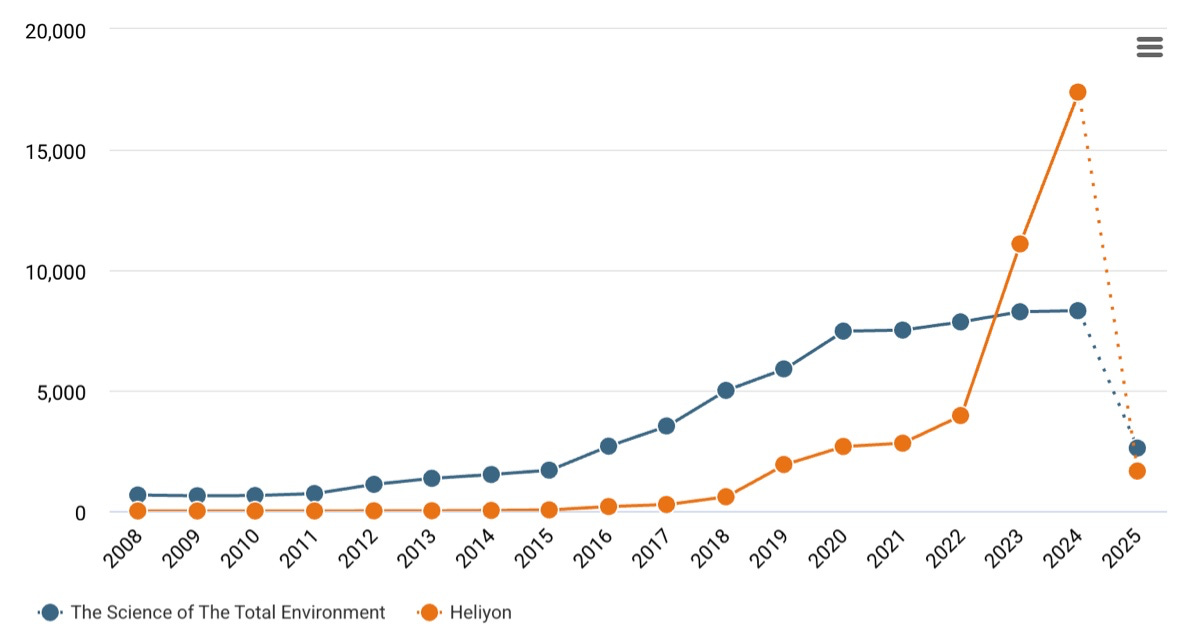
Science of The Total Environment is a hybrid journal with an APC $4150. Hybrid open access article output is set to drop by around 600 articles in 2025, which would create an OA revenue shortfall of around $2.5 million. Heliyon is probably down by around $30 million, according to my back-of-the-envelope calculation (N.B. The volume of APC waivers is the big unknown in both estimates).
The El Pais journalist, Manuel Ansede, wrote this about the former editor-in-chief of Science of the Total Environment, who is Spanish:
Damià Barceló, 71, took over as editor of the journal in 2012. In just two years, he doubled the number of studies published. In a decade, he increased the number tenfold, with the journal reaching nearly 10,000 articles annually.
Barceló has published over 1800 papers in his lifetime, according to the El Pais article, with “more than 200 of them in Science of the Total Environment, his own journal.” Ansede continues:
The Elsevier spokesperson explained that Barceló “stepped down” as editor-in-chief in March 2025. “This change was part of a broader effort to strengthen the journal’s governance and address concerns raised,” the spokesperson stated. Elsevier maintains that the “systemic problems” that led to the expulsion of Science of the Total Environment “cannot be attributed to any single individual.”
The table below shows the 10 journals that shrank the most in 2025 (year-to-date) compared with 2024 (full year), using data from Dimensions (research articles and review articles). Unsurprisingly, many of the journals have recently been delisted from Web of Science. Between them, Springer Nature and Elsevier feature seven times on this ‘top 10’ table.
