

How did the largest academic publishing companies perform in 2025?
I read the commercial publishers' annual reports so that you don't have to.
Hello fellow journalologists,
Around this time of year the largest commercial publishers release their annual reports. These, often lengthy, documents contain lots of useful and important information for people working across the academic publishing sector.
Furthermore, the CEOs and CFOs are often quizzed by investors on their business strategy and future expectations, which can provide useful insights.
Over the past few weeks I’ve spent many hours delving into the annual reports and investor information; I’ve extracted nuggets that are likely to be of interest to Journalology readers. Rather than write one very long newsletter, I’ve decided to split the coverage over the course of a few weeks to make it easier for readers to digest.
Today’s email sets the scene. In the coming days I’ll publish newsletters that cover one or more companies.
My primary goal is to help publishing professionals, of all levels of seniority, to better understand the marketplace that they’re working in. If you aspire to rise to a leadership or management position you need to understand the market trends and what your competitors (and potential future employers) are up to.
I’ll do my best to explain some of the financial terminology that’s used in the reports and help you to understand each company’s current strategy (N.B. This is definitely NOT investment advice!).
Over the next few weeks paid subscribers to Journalology will receive emails analysing the following companies, based on the data released in their recent 2025 annual reports:
Elsevier
Springer Nature
Wolters Kluwer
Sage
Taylor & Francis
MDPI
Frontiers
Wiley (annual report won’t be released until June)
Collectively, these eight publishers account for around 40% of research and review journal articles published globally.
The annual reports need to be interpreted carefully — they all tell a tightly controlled corporate story — but they provide a unique insight into the companies’ priorities that often isn’t revealed elsewhere.
Article market share
The information I’ll present in future emails will largely come from the eight companies’ themselves. They each have their own way of presenting financial and non-financial data and it can be difficult to compare apples with pears (and USD with GBP and EUR).
So I thought I would set the scene by showing you how journal article output has changed over the past 10 years. The green bars depict the total number of research + review articles published in academic journals globally (i.e. all publishers, not just the eight publishers listed in yellow).
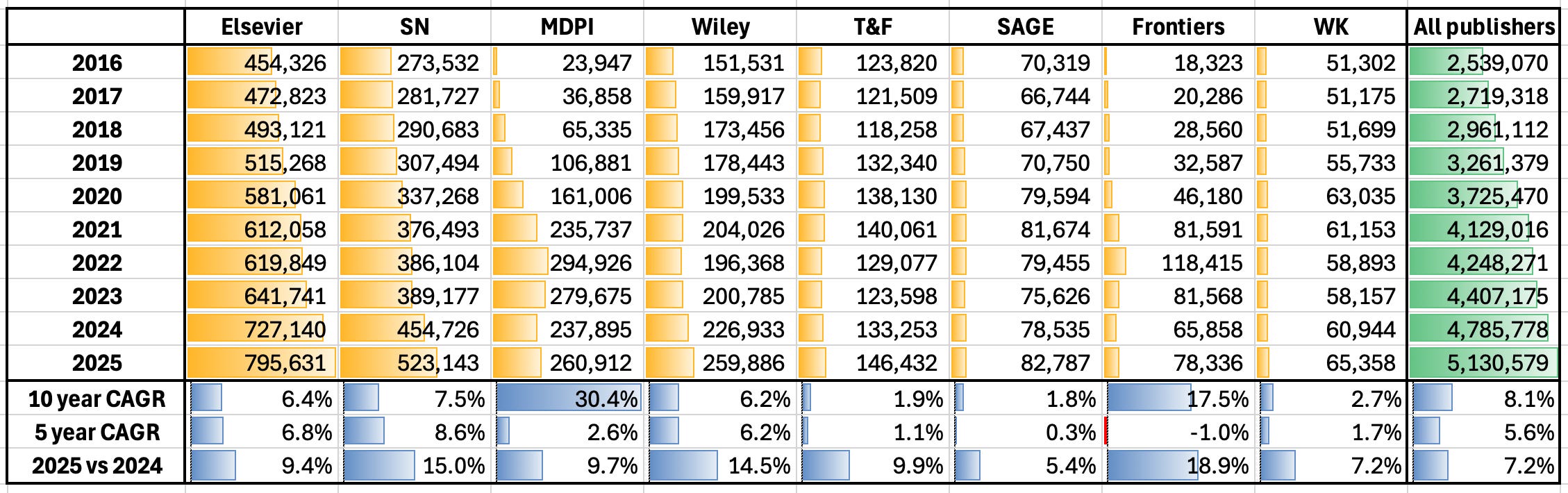
‘CAGR’ is compound annual growth rate, a way of measuring growth over time. I’ve calculated two CAGRs, one over the last 10 years and another over the last 5 years.
You can see from the bottom right of the table that the 10-year CAGR for the article market as a whole was 8.1% and the 5-year CAGR was 5.6%.
The 10-year CAGR for Frontiers and MDPI is much higher than the 5-year CAGR because their output peaked in 2022 and then dropped. The 5 and 10 year CAGRs for the established publishers is much more internally consistent.
The year-on-year article growth in 2025 vs 2024 tells an important story. The established commercial publishers grew much faster in 2025 than their historical CAGRs.
Springer Nature and Wiley both grew their article output by around 15% last year compared with 2024. Taylor & Francis and Elsevier grew by around 10%. Sage and Wolters Kluwer, which historically grew year-on-year in low single digits, managed between 5 and 7% growth. The article market as a whole grew by about 7% last year.
It can be inaccurate to do market-share calculations at this point in the year because data for many of the smaller publishers won’t be in Dimensions yet.
However, with that caveat in mind this is what the annual market share looks like — at this point in time — for the eight publishers. The 2025 numbers could change slightly in the future as more articles are added to Dimensions:
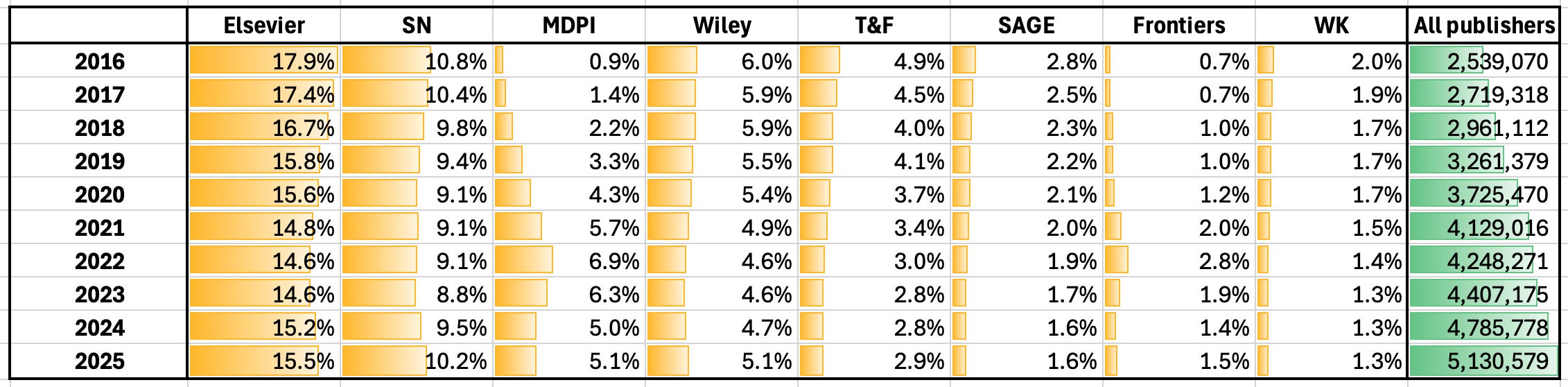
The yellow columns show the market share for each publisher in the calendar year. Elsevier and Springer Nature are getting close to recovering the ground they lost when open access kicked in around 2018, with MDPI and Frontiers growing rapidly at that point in time.
2025 was a particularly important year in the history of scholarly publishing. It will be remembered as the year AI tools were used at scale by researchers to help them to become more productive, producing financial opportunity for publishers but also considerable reputational risk because of research integrity challenges.
The publishers’ annual reports naturally tend to focus on the positives, and brush over the negatives, but are interesting to explore nonetheless. However, they are generally LONG. But don’t worry — I’ve read them in detail so you don’t need to.
First up is Elsevier, which will arrive in your inbox tomorrow.
Until next time,
James