

IEEE: 2025 in review
An analysis of IEEE's publishing programme in 2025

Hello fellow journalologists,
We’re now in the second half of 2026, so it feels slightly odd to focus on what happened in 2025. However, annual reports often arrive slowly.
Initially, I was planning to do a round up of recent company updates in today’s email. I’ve changed tack a little and have decided to focus entirely on IEEE (Institute of Electrical and Electronics Engineers; generally pronounced “eye-triple-e”), the largest of the society publishers, instead.
As is so often the case, I went down various rabbit holes as I attempted to better understand their publishing programme. It felt like a good idea to separate the company analyses to make it an easier (and quicker) read for you.
There should be some useful lessons in this essay for people who work on subject areas outside of engineering and computer science. Although with AI front and centre of all of our minds, I’d argue that we should all be learning more about the computing publishing landscape.
IEEE financials
On July 16 the IEEE released its annual report for 2025. The IEEE is possibly the largest academic society, with more than 500,000 members. Their publishing programme is certainly the largest of the academic societies and supports much of IEEE’s activities.
IEEE’s total revenue in 2025 was $666 million, an increase of 3% on 2024. The Periodicals division contributed just under half of that total and had a good year financially in 2025; revenues increased by 11.6% to $321.5 million and expenses increased by 11% to $216.8 million.
So total revenues grew by 3% for IEEE as a whole, but publishing revenues increased by nearly 12%, which suggests that the other divisions within IEEE did not fare as well.
The table below shows the absolute change in revenues and costs for the four divisions listed in the financial report. Revenues increased for Periodicals, but fell for the other three divisions. Expenses increased (almost) across the board (you can access the financial data here).
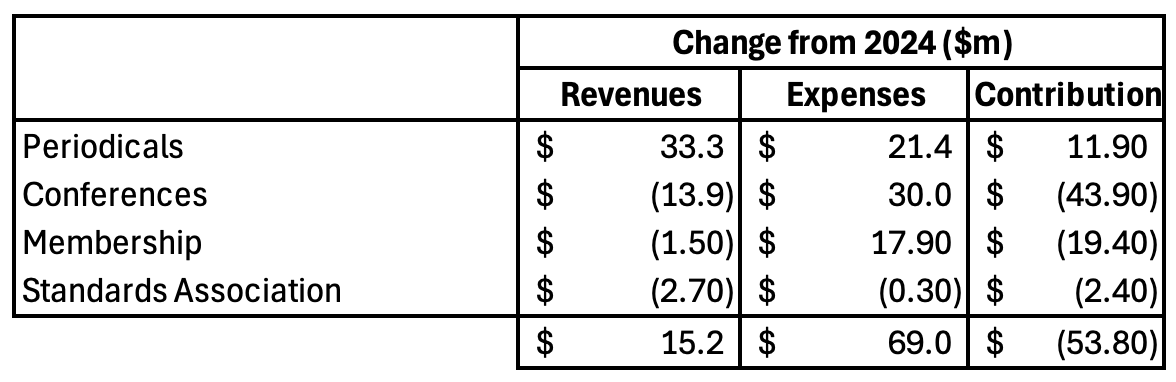
This shortfall between 2024 and 2025 was counteracted by investment gains of $150 million in 2025, up from $90.5 million in 2024. In short, investments in other companies helped to save the day.
By the end of 2025 the net assets of IEEE were $1.26 billion, so IEEE won’t be going out of business any time soon. Its financial reserves are deep.
The annual report is light on detail about the publishing group’s activities; it focuses (briefly) on three areas:
The IEEE Xplore Digital Library now hosts 7 million documents
IEEE journals did well in the recent impact factor announcements (see press release for details)
IEEE has improved its research integrity capability and rolled out the STM integrity hub to all its journals (the Retraction Watch page for IEEE gives some examples of why this was needed)
Last week, IEEE Spectrum, a news magazine, published a summary of the research integrity activities:
The new features include the Clear Skies Papermill Alarm, which helps identify potentially fraudulent manuscripts at submission. Another is an integration with the PubPeer database, which allows users to check whether references in a manuscript have received previous PubPeer comments or have been retracted—both of which can indicate quality or integrity issues. The duplicate submissions detector can determine whether the same manuscript has been submitted to multiple journals by different publishers, often a sign of academic “paper mill” activity.
The research integrity team has certainly been busy recently. The first sentence in this extract is both shocking and unsurprising in equal measure.
Last year 591 cases were opened, a 56 percent increase over 2024. Of the 591 reports, 317 were closed and 274 are still under investigation. Of the complaints, 88 percent were research-related, including issues with plagiarism, AI-generated text, and falsification of—or unauthorized use of—data. The other 12 percent involved alleged misconduct by editors, reviewers, and conference organizers.
The complexity of the reported cases has expanded. An increasing number of the complaints deal with more than one article or complicated situations such as editorial misconduct or peer-review manipulation.
IEEE Bibliometrics
The annual report provides little information about the publishing programme itself, so here’s an overview using data from Dimensions).