

Journalology #136: Guest editors
Hello fellow journalologists,
I’ve had a busy week attending the Academic Publishing Europe (APE) meeting in Berlin. I’m not a big fan of conference reports, so I won’t attempt to summarise what was said in this newsletter. Videos of some of the sessions are already available to view here; they should all be publicly available within a month, I understand.
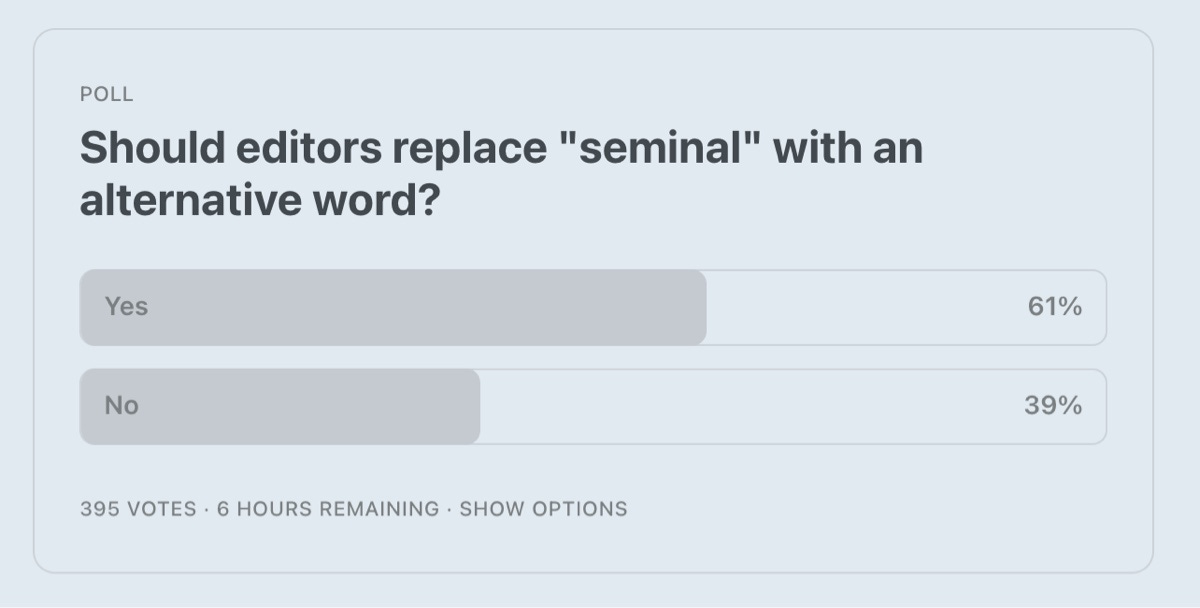
Last week I asked you to vote on whether editors should replace ‘seminal’ with an alternative word (if you missed last week’s issue, you can read the rationale here). Nearly 400 of you voted with 61% voting “yes”. Style guides will need updating.
This week’s newsletter focuses almost entirely on news stories and announcements. If I’d included snippets from opinion articles too, the newsletter would have been 2-3 times longer.
However, there’s still plenty to get your teeth into. All subscribers can read the five stories included in the “news headlines”; paid subscribers also have access to around 30 other articles that appear below the subscription fold, including a handful of deep dives from me on stories that grabbed my attention.
News headlines
New Report Documents Publisher Investment in Research Integrity Infrastructure
A new report, released today, offers the first collective look at the range of approaches scholarly publishers are deploying to tackle threats to research integrity, threats that have evolved in nature and scaled dramatically in recent years. The STM-commissioned report was researched and compiled by research firm Research Consulting, which conducted in-depth interviews with 18 research integrity and publishing experts across 13 organizations. It documents significant capacity building in recent years. Some publishers now maintain dedicated research integrity teams that number more than 100 staff members and screen millions of manuscript submissions annually. They do so using innovative and evolving detection systems that enlist technology, but keep humans at the center of the work.
JB: The STM report can be downloaded here and was announced at the APE meeting. It summarises the various ways that publishers are trying to overcome research integrity challenges, based on interviews with 18 research integrity experts from 13 organisations. The key takeaway is:
The report identifies three pillars of publisher practice: capacity (dedicated teams and screening technology), practice (standards, screening protocols, and training), and coordination (shared detection tools and infrastructure). Major collaborative initiatives documented in the report include the STM Integrity Hub, which now includes 49 organizational members, the Committee on Publication Ethics (COPE) with 106 publisher members representing over 14,500 journals, and United2Act, a coalition of 58 organizations coordinating responses to paper mills.
AI tools boost individual scientists but could limit research as a whole
Writing in Nature, Hao et al. report a paradox: the adoption of AI tools in the natural sciences expands scientists’ impact but narrows the set of domains that research is carried out in. The authors examined more than 41 million papers, roughly 311,000 of which had been augmented by AI in some way — through the use of machine-learning methods or generative AI, for example. They find that scientists who conduct AI-augmented research publish more papers, are cited more often and progress faster in their careers than those who do not, but that AI automates established fields rather than supporting the exploration of new ones. This raises questions and concerns regarding the potential impact of AI tools on scientists and on science as a whole.
JB: If you want an easy-to-read news story about this Nature paper, then AI has supercharged scientists—but may have shrunk science is probably the place to go.
Sage journal retracts more than 40 papers over concerns with peer review, author contributions
Sage has retracted 45 papers from one of its journals for questionable authorship and peer review. The publisher began an investigation into Clinical Hemorheology and Microcirculation last year to address citation concerns, a Sage spokesperson told Retraction Watch. The journal was one of 20 titles that lost their impact factors in Clarivate’s 2025 Journal Citation Reports for excessive self-citation and citation stacking.
JB: This journal was part of the 2023 IOS Press acquisition, Retraction Watch notes:
Sage has retracted more than 1,500 articles from another former IOS Press journal, the Journal of Intelligent & Fuzzy Systems, for problematic peer review and other issues. The publisher was one of the first to retract problematic papers in bulk.
The academic community failed Wikipedia for 25 years — now it might fail us
However, generative-artificial-intelligence systems trained heavily on Wikipedia are now threatening the future of this free, volunteer-driven resource. The stakes have changed — and academics must take note. Large language models offer instant, Wikipedia-derived answers without any attribution. When AI chatbots provide seemingly authoritative responses drawn from Wikipedia’s very pages, why would anyone navigate to the source, let alone contribute to it? This parasitic relationship endangers the last bastion of freely accessible, human-curated knowledge and undermines the premise of collaboration on which many of Wikipedia’s knowledge-sharing practices rely.
JB: The key point here is “without attribution”. This week Nature also ran a Q&A with Jimmy Wales’ about his new book The Seven Rules of Trust: Why It Is Today’s Most Essential Superpower. My copy arrived yesterday and I’m looking forward to reading it. The word “trust”, or its derivations, appears 8 times in this newsletter. It’s possibly the single most important word that we all need to consider right now.
2025 Readership Survey - The Scholarly Kitchen
TSK remains the leading source of information for its readers at 75%, in the face of growing competition from The Brief (28%) and Journalology (28%). Respondents also prioritize email notifications from outside organizations (48%) and directly visiting professional news sites (25%) as very important for discovering key developments. LinkedIn is emerging as the social media outlet of choice (64%), with a notable decline in X (Twitter), which is now of the lowest interest (15%).
JB: 714 people responded to the 2025 TSK survey compared with 2750 people to the 2021 TSK survey. There are a handful of reasons why that might be the case. Regardless, I’m delighted that Journalology is mentioned alongside those two established (and primarily US) opinion outlets.