


Hello fellow journalologists,
Journal publishing has got more complex over time. Every year new initiatives are launched, new checklists are created, and bad actors develop new ways to game the system.
AI has been pitched as a time saver, but the way it interfaces with scholarly information is operationally challenging, as we we will see in the extracts that follow.
Position paper: persistent identifiers in research infrastructure policy
Persistence is not simply a property of being digital. True persistence requires active governance, long-term financial commitment, and organisational stewardship. An identifier service whose maintaining organisation fails, or whose governance collapses, is not persistent in any meaningful sense. Sustainability and governance are core requirements rather than secondary considerations.
JB: I chose the above quote from Crossref’s position paper because I want to draw particular attention to the importance of financial sustainability for critical shared infrastructure.
If you’re new to scholarly publishing, this extract from Wikipedia provides some background on Crossref, which serves a vital role in academic publishing:
Crossref is a nonprofit open digital infrastructure organization for the global scholarly research community. It is the largest digital object identifier (DOI) Registration Agency of the International DOI Foundation. It has 23,000 members from 164 countries representing publishers, libraries, research institutions, and funders and was launched in early 2000 as a cooperative effort among publishers to enable persistent cross-platform citation linking in online academic journals.
A few weeks after releasing the position paper, Crossref announced that it is investing $4.9 million of our surplus in rebuilding the Crossref system. The surplus aspect is important, and we’ll come back to that soon, but first let’s explore why this investment is needed:
The two largest components of the current architecture are the Content System (CS) and the REST API. Both function as monoliths. They use mono-repositories, and their internal components are tightly coupled. Over time, they have accumulated complexity, substantially expanding beyond their original purpose. Each of them is now responsible for many different functions, with different needs and characteristics. This monolithic and tightly coupled architecture makes it difficult to maintain, scale, or expand our system. Adding new functionality often requires workarounds, which further increases complexity and adds technical debt.
The bold text is mine: increasing complexity is the theme of this newsletter after all.
A day after the position paper was published, Crossref announced: Fee update: lowering and removing DOI registration fees in January 2027.
We have some rather unusual news to share: Crossref fees are going down again. At its meeting in Paris earlier this month, the Crossref Board approved two further recommendations from the Resourcing Crossref for Future Sustainability (RCFS) project: effective 1st January 2027, we will reduce the majority of Content Registration fees for all 25,000 members, and remove fees for back-year records altogether.
So Crossref is both reducing its fees and also investing $4.9 million of its surplus to update its core infrastructure. How has it managed to commit to that?
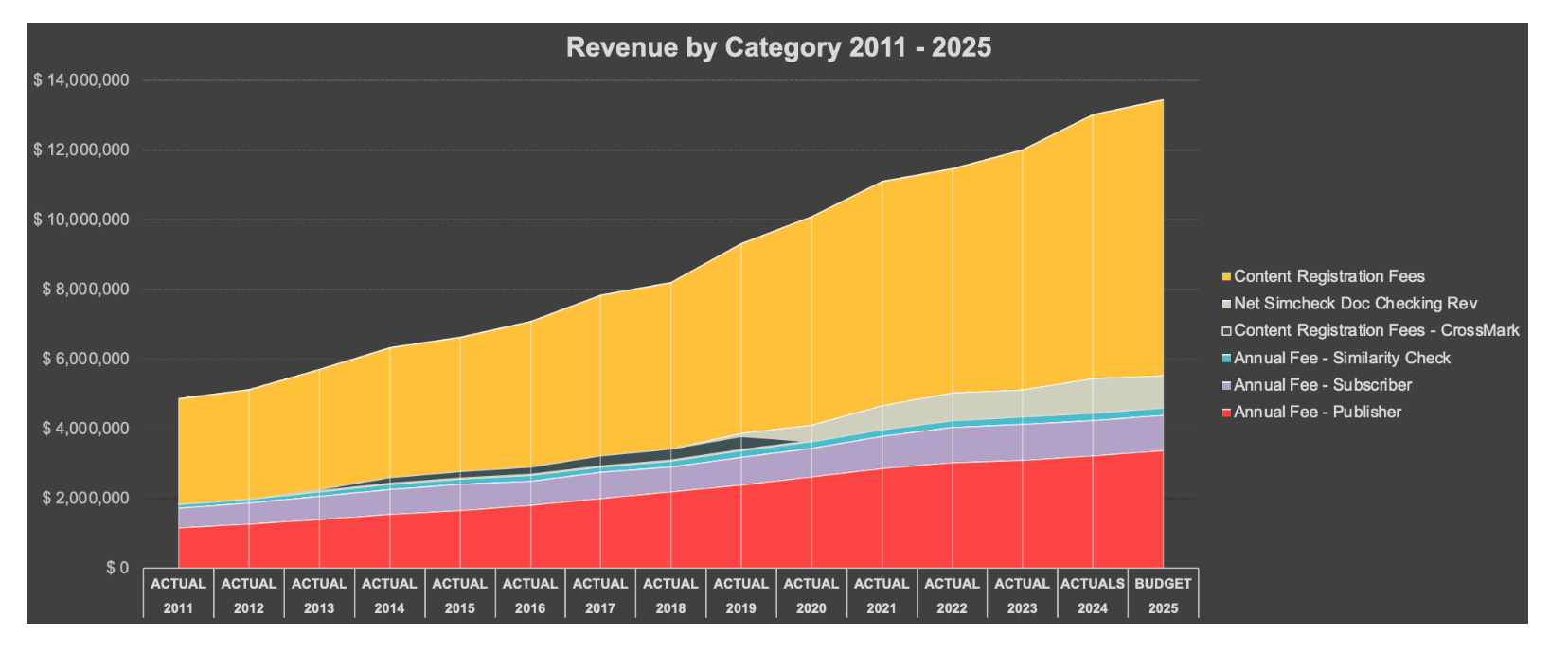
The Crossref 2025 financial report is enlightening. Revenues have increased steadily over time, which is unsurprising since Crossref generates a large chunk of its revenues from “content registration fees”: publishers pay $1 for every DOI minted, and since global article output has grown over time, so have Crossref’s revenues. Generating a surplus is a good thing. It allows the organisation to invest in updating its infrastructure to keep it sustainable and efficient.
Contrast this with the news about the Open Science Framework, which will have reduced functionality because of funding problems:
These changes are necessary because of a challenging funding environment for open research infrastructure. Important background about why we are making this change is available in a separate post. Our priorities are to support the long-term discovery and access of content publicly shared on OSF so it remains persistent, discoverable, and accessible, and to ease the transition for users to continue doing open science.
Crossref has thousands of institutional members that pay a membership fee and service charges. OSF, by contrast, relies mainly on grants:
If we were sticking to our expansive vision for OSF as a comprehensive collaborative management system, we would need to continue raising $4-5 million per year for the next several years. We generate 10 to 20% of that through sustainable yearly revenue, mostly provided by several dozen institutional members. The remainder would have to be solved with grants. That’s a lot of grant writing success, even in the best of times. We are not in the best of times.
The take home message is that core infrastructure needs regular, repeatable revenue in order to be sustainable; grants are not enough. Even nonprofits need to generate a surplus, so they can update the underlying technology that their stakeholders rely on. Furthermore, costs will likely rise in the future as complexity increases.
The goal of the Journalology newsletter is to provide insight into the key trends in academic publishing. I want to help readers to see the wood for the trees; to sort the wheat from the chaff. Please consider supporting the newsletter by upgrading your subscription either for yourself or for your team.