

The Jist: Editorial independence
The Jist provides readers with the gist of recent news stories, written by journalists, that cover events in scholarly publishing. Paid subscribers to Journalology also receive an in-depth analysis of recent publishing industry developments, sent mid-week. You can upgrade your subscription here.
Hello fellow journalologists,
This week I delve into the third most highly cited paper of 2025, which was published in a journal that launched the previous year. The article’s corresponding author, the journal’s owner, and the journal’s Editor-in-Chief have quite a lot in common: 46 chromosomes in common, in fact. Read on to find out more.
News headlines
Controversial editorial practices boost plastic surgeon’s publishing empire
Although practices vary, the journals Agha founded aren’t alone in requiring authors to follow, and sometimes even cite, reporting guidelines. But a conflict of interest can arise when an editor demands authors reference guideline papers published in the editor’s own journals – as Agha does in his instructions to authors, reporting guidelines and editorial correspondence.
Retraction Watch (Frederik Joelving)
JB: This Retraction Watch news story primarily focuses on the journals that Riaz Agha, a plastic surgeon and entrepreneur, sold to Wolters Kluwer in 2022.
Riaz Agha went on to found Premier Science, which publishes 21 journals. I didn’t know much about the portfolio, so I decided to do some digging. This is what I found.
Each journal in the portfolio is prefixed with Premier Journal of xxxx and most have published only a handful of papers. The first journals started publishing articles in 2024.
Riaz Agha and Mahlia Agha (the co-owners of Premier Science) were authors on three highly cited papers that appeared in the flagship title, Premier Journal of Science in 2025 (source: Dimensions).
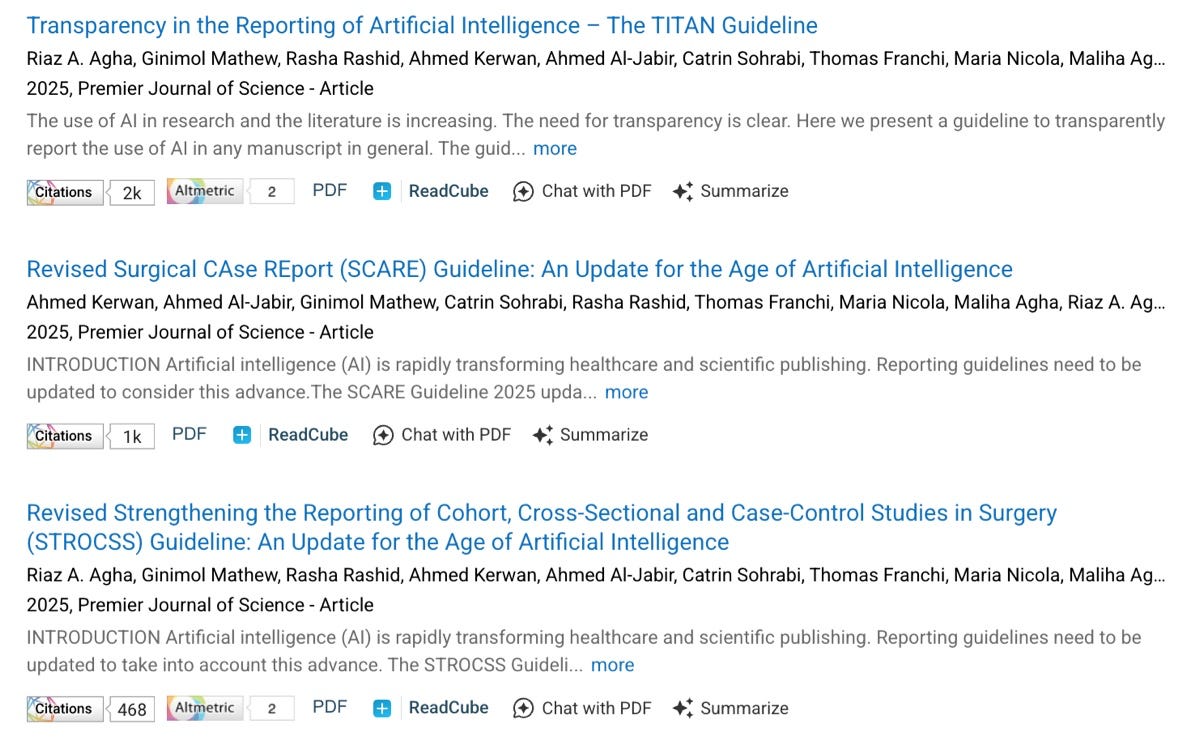
The first paper — a guidelines paper published in June 2025 — has received 2000 citations in the past 9 months. Indeed, this paper is the third most highly cited paper (published in any journal globally) of 2025. Riaz Agha is the corresponding author.
A Waybackmachine snapshot taken on August 3, 2025, lists Riaz Agha as the Editor-in-Chief of Premier Journal of Science.
In other words, it appears that the journal’s Editor-in-Chief, owner, and corresponding author of its most highly cited paper are one and the same person. The conflicts of interest statement for the TITAN Guidelines paper reads:
The authors have no financial, consultative, institutional, or other relationships that might lead to bias or a conflict of interest.
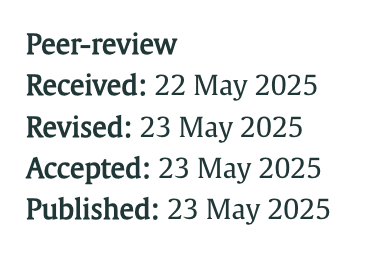
It’s not clear who the handling editor was for the paper or if Riaz Agha, the corresponding author (and Editor-in-Chief), was involved in the editorial assessment process. Peer review certainly happened fast:
The Committee on Publication Ethics (COPE) has this to say about editorial independence:
The relationship of editors to publishers and journal owners is often complex but should always be based on the principle of editorial independence. Notwithstanding the economic and political realities of your journal, you should select submissions on the basis of their quality and suitability for readers rather than for immediate financial, political or personal gain.
It’s worth noting that Riaz Agha is no longer the Editor-in-Chief of any of the Premier Science journals and is listed as the Founder and Publishing Director. His biography states:
Dr Agha is also a Practising Plastic Surgeon working in London’s Harley Street having completed his training in the London Deanery in April 2020. He is also President-elect of the Section of Plastic Surgery at the Royal Society of Medicine. In 2018, he was awarded a doctorate at Balliol College, University of Oxford where he was a Clarendon Scholar (awarded to the top <1% of 20,000 applicants).
What’s driving the rise of Chinese journals?
Yet Chinese publishers still face major challenges. Cao says Chinese scientists still prefer publishing in international journals, partly because getting published in China often depends on being in the right networks. “International journals are perceived to be fair, transparent,” he says.Publishing in international journals also makes it more likely that Chinese academics’ work will be read. Even when Chinese-language journals produce abstracts in English, few academics from outside the country have the language skills to verify what the abstract says. “Not many international scientists read Chinese,” says Cao. “That affects the spreading of knowledge produced in China.”
Research Professional News (Harriet Swain)
JB: This article provides an excellent overview of some of the current market dynamics in China (N.B. paywall).
A few people have told me recently that they don’t believe that China will dominate high impact science in the future. Read these three news stories, which were published in the past week, to see if you agree:
Top brass in China reaffirm goal to be world leaders in tech, AI
How Chinese labs race for the next ‘first-in-class’ breakthrough
To address these shortcomings, the team is releasing CiteAudit, which they say is the first comprehensive, open benchmark and detection system for hallucinated citations. The dataset includes 6,475 real and 2,967 fake citations. A generated test dataset contains fakes from models like GPT, Gemini, Claude, Qwen, and Llama. The real test dataset draws from actual hallucinations found in papers on Google Scholar, OpenReview, ArXiv, and BioRxiv. The researchers systematically categorize hallucination types, from subtle keyword swaps in titles and fabricated author lists to fake conference names and made-up DOI numbers.
The Decoder (Jonathan Kemper)
Scientific sleuths come in from the cold
Some research integrity practitioners agree that standards for their sleuthing work is needed, but others in the idiosyncratic field think the process doesn’t need defining or labeling. Instead, they argue that constructive criticism of researchers and the articles they publish should be considered an integral part of the scientific process—and the responsibility of the academic community as a whole. It’s a healthy debate in a field populated by an eclectic assortment of people, many of whom take pleasure in searching for, and publicizing, scientific fraud. They often labor in isolation on nights and weekends, alongside full-time jobs.
Chemical & Engineering News (Dalmeet Singh Chawla)
Embattled journal brand mistakenly invites out-of-scope researchers to join board
Springer Nature has launched a new agriculture journal under the troubled Cureus brand. As part of its launch, the publisher invited at least one researcher with irrelevant specialities to join its editorial board, Retraction Watch has learned.
Retraction Watch (Avery Orrall)
JB: Yeah, that happened to me too. On November 15, 2025, I received this email:
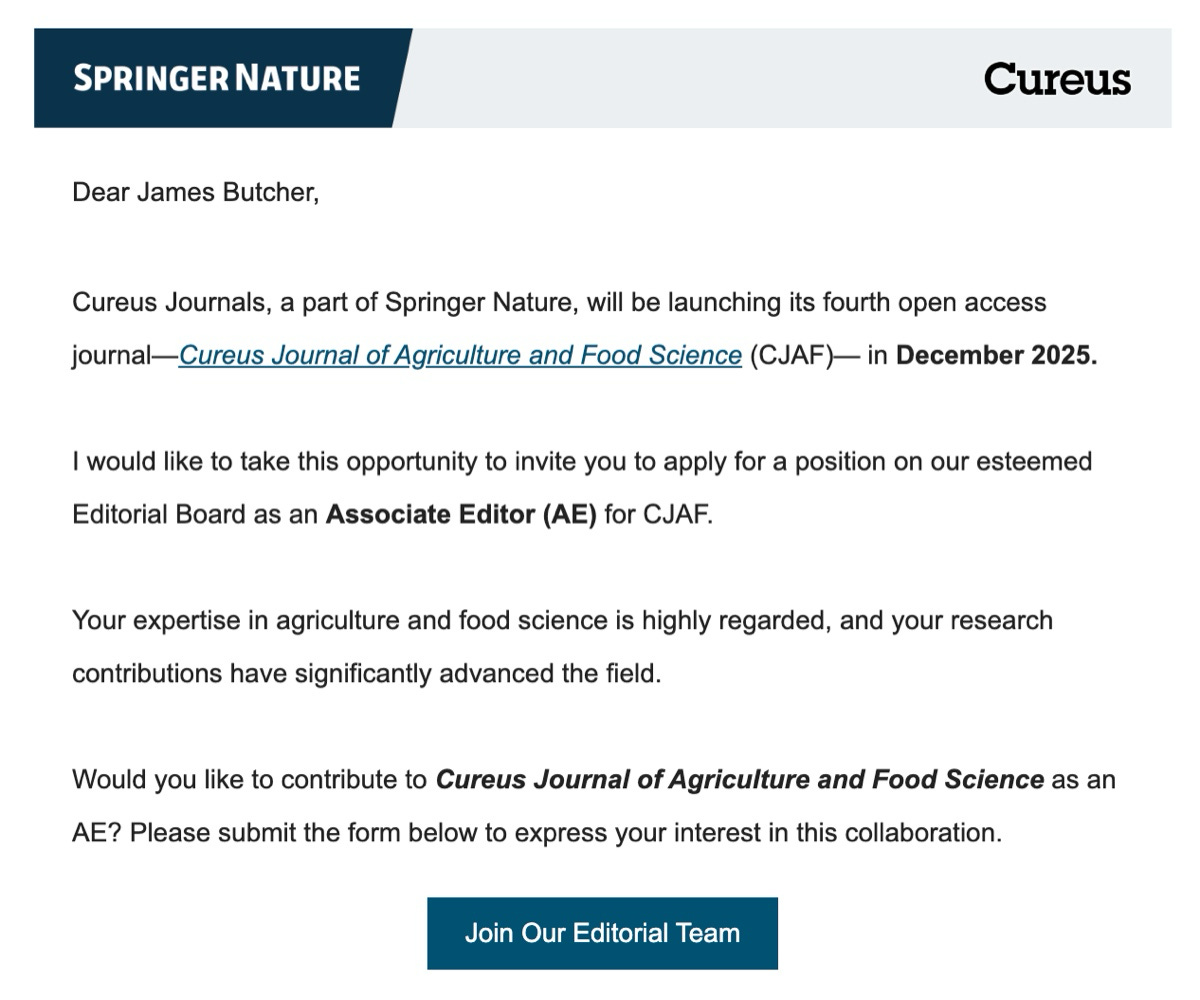
My PhD is in neurophysiology and I haven’t published a research paper since 1998. I know very little about agriculture or food science.
Needless to say, inviting the person who had recently published Cureus loses its impact factor, to apply to join the editorial team of a spin off Cureus journal could be considered to be a bit of an own goal.
I approached my former Springer Nature colleagues for comment shortly after receiving the email last November; I thought about writing a story about the marketing email, but decided against it. Glitches happen during IT migrations, after all.
Recruiting editors by emailing people who have signed up to eAlerts feels icky to me; some might argue that it’s not much different from posting an editorial job advert online. A Springer Nature spokesperson told me at the time:
Just to be clear – the email was a call to apply, intended for a small subset of relevant researchers, inviting them to apply. Once we receive applications for the role, we have stringent processes to vet applicants (credibility, integrity, etc.) and interview them before we appoint them. Once appointed, we constantly review the quality and integrity of editorial work.
How bioRxiv changed the way biologists share ideas – in numbers
In total, researchers have now posted more than 310,000 preprints to bioRxiv since it first launched in 2013, and the site receives about ten million views every month (see ‘The growth of bioRxiv’). The work also hints that the benefits of quick dissemination of research are winning over fears that the lack of peer review in preprints could cause a loss of rigorous quality control in scientific publishing.
Nature (Chris Simms)
JB: I covered this report in the newsletter that I sent to paid subscribers on Wednesday. Unfortunately, the Nature news editors decided to reproduce the bottom half, but not the top half, of Figure 4 in the report. Plotting cumulative submissions over time makes it look as though bioRxiv has grown much faster than it actually has.
Keep calm and be transparent: advice from scientists who retracted their papers
Research has shown that when authors self-retract because of honest mistakes, their earlier work continues to be cited. These data, along with anecdotes such as King’s story, suggest that attitudes about retractions might eventually shift. Nature reached out to scientists who have openly retracted their studies, and asked about their experiences and lessons learnt.
Nature (Sofia Caetano Avritzer)
JB: This story should help reassure academics that correcting mistakes via a retraction will likely not adversely affect their career.
And finally…
I thoroughly enjoyed this Nature podcast: Nervous networker or conference presenter? Just care less, says voice coach Susie Ashfield.
In fact, I enjoyed it so much that I went ahead and bought Susie’s book: Just F**king Say It: The Ultimate Guide to Speaking with Confidence In Any Situation.
I’ve only read a few pages so far, but this extract from the introduction made me enthusiastic to read more:
James is going to do it. He’s going to go out there and just f**king say it… He will speak, and it’ll sound as though something brilliant just popped into his head on the way to the stage.
Excellent! That’s just what I need and is certainly worth the £0.99 Kindle entry fee.
Until next time,
James
P.S. Editor friends: should it be Mother’s Day or Mothers’ Day? I attended a school play this week that had banners with Mothers Day emblazoned on them. Ugh.
My mother would always insist it was not the commercial Mother’s Day (originally relating to Mother Church), but Mothering Sunday. Otherwise known as Refreshment Sunday, the mid-point of Lent, on which she would ‘refresh’ herself with a selection from a box of Black Magic chocolates.