

The Jist: July 8 to July 27
Get the gist of recent news stories, written by journalists, that cover topics related to scholarly communication.

Hello fellow journalologists,
I’ve recently returned from a summer vacation feeling rested and restored. If you’ve been away too, today’s newsletter should help you to get back up to speed.
As a reminder, the purpose of The Jist is to summarise how news outlets have been covering scholarly communication.
AI’s top startups are barely publishing their research
Today’s biggest artificial intelligence (AI) startups make no shortage of bold promises. Their technologies, some boast, will revolutionize software development, drug discovery, and scientific research.
Yet a new preprint posted last week on bioRxiv suggests many of these firms barely participate in one of science’s most fundamental practices: publicly documenting discoveries in scientific literature so other researchers can evaluate and build on them. More than half of AI unicorns—private companies valued at more than $1 billion—have never played a leading role in publishing a scientific paper or preprint, according to the new analysis. Collectively, they accounted for just one in every 1000 AI papers published in 2025.
Science (Celina Zhao)
JB: The last author of the preprint referred to in this story is John Ioannidis:
Ioannidis has long studied how unicorns, particularly in biotech, engage with the scientific literature. (In 2015, he was the first to publicly scrutinize the lack of peer-reviewed studies produced by Theranos, the blood testing startup that proved to be based on fraudulent data.) He wondered whether AI unicorns would show similar patterns.
We shouldn’t be surprised by this finding. Journal publishing is a slow process and AI is moving fast. Press releases and blog posts are quicker and easier to produce than a research paper. Protecting intellectual property is a consideration for AI firms too. Pharmaceutical companies are constrained by regulation in a way that AI companies are not. Drug safety is paramount. Surely AI safety should be too, as the recent Hugging Face hack by OpenAI’s latest model has demonstrated.
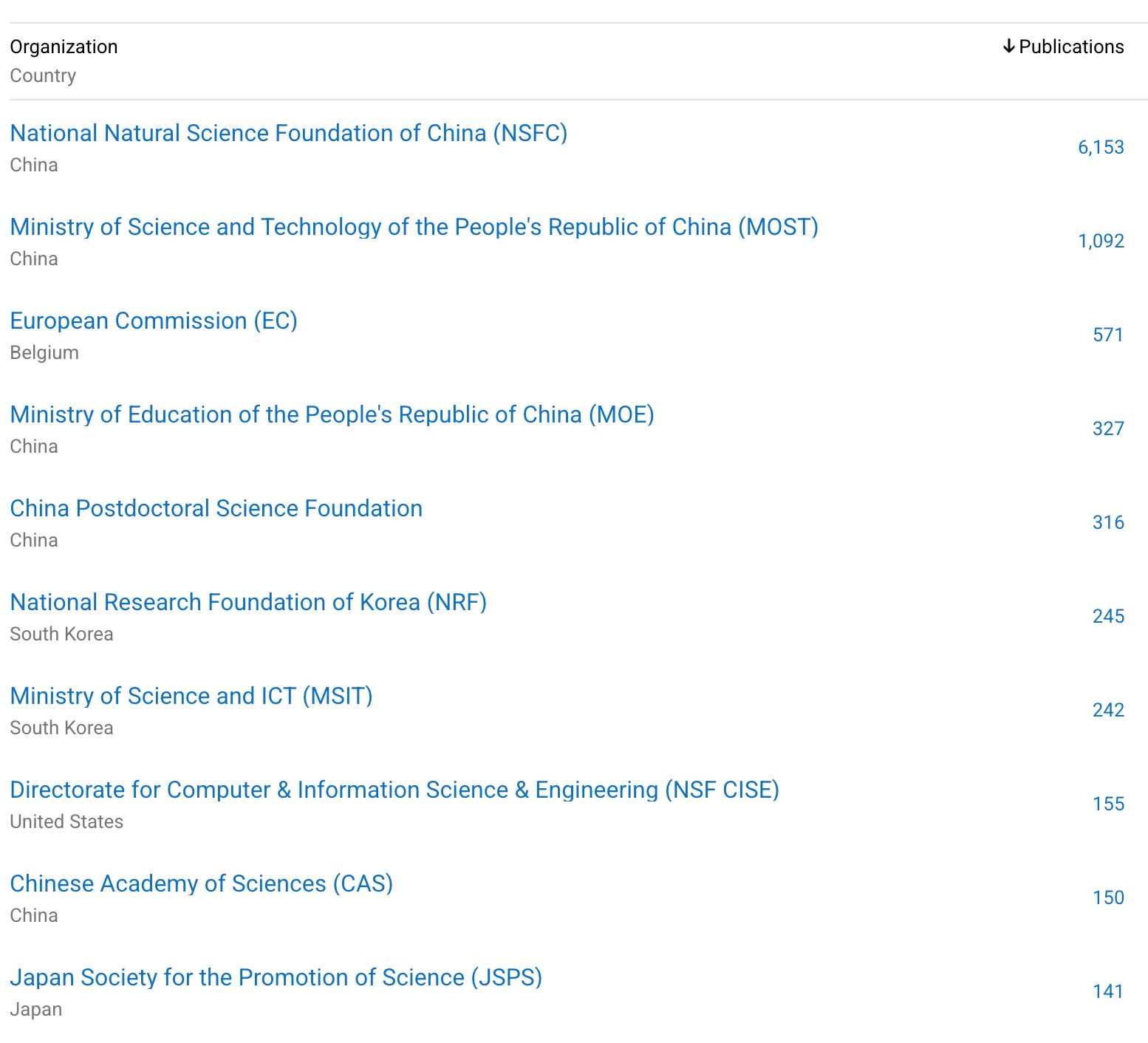
So who is funding AI research that’s published in journals? The answer, according to Dimensions, is important for editors and publishers to understand. Academic AI research is driven almost entirely by Asia, even though the commercial centre of power is in the USA.

Editors of economics journal resign after association renews Taylor & Francis contract
Veneziani said the editors are planning to launch a diamond Open Access journal, the Journal of Social Economy and Philosophy, under Stanford University Press. The journal would be more affordable for authors and readers, he said. Alan Harvey, director of Stanford University Press, confirmed the press is in discussions with the editors about a new proposed journal under the publisher’s Subscribe 2 Open program, which was “specifically established to address the growing concerns around commercial scholarly publishing practices.”
Retraction Watch (Avery Orrall)
JB: Is it possible to launch a new journal under the S2O model? The underlying premise of S2O is that if insufficient institutions commit to supporting ‘open’ then the content will revert to a subscription model. But a new journal wouldn’t have any subscription sales to fall back on. So how would it work?
Four takeaways from our investigation into a hidden gene-editing death
Nearly a year after Mei’s death, the academic team that developed her therapy published a paper in Nature presenting evidence that it worked in mice and monkeys. Although a draft of the paper referred to the family’s genetics and acknowledged the parents’ financial support of the research, those details had been stripped from the final paper. The parents had asked the team to withdraw the paper before publication and sent a letter of protest to Nature after it came out, mentioning their financial support of the trial and their daughter’s death. The journal told them the ethical issues “fall outside our purview in terms of data integrity” and that the matter should be handled by the university. In response to our questions, an editor at Nature said that during the paper’s review process the journal was not aware of Mei’s death or related issues, such as the sanctions the hospital received for insufficient oversight.
Science (Science news staff)
JB: This story relates to the tragic death of a 6-year-old girl after gene therapy; the preclinical work was published in Nature. Science and Retraction Watch collaborated on the original news story: Exclusive: Death of girl in Chinese gene-editing trial was never made public and followed up yesterday with Chinese university launches probe into girl’s gene-editing death.
Could small-team science be dying out?
[Chaoqun] Ni suspects that rather than dying out, small-team science will stabilize. It might even see a resurgence as artificial-intelligence tools become more sophisticated and accessible, she adds.
…
AI tools are becoming more powerful all the time, says Thelwall, adding that one collaborator has already replaced him with ChatGPT to write code for some papers. “Generative AI is definitely a reason why smaller teams can now do the job of a larger team.”
Nature (James Mitchell Crow)
JB: Could the trend towards larger author groups change with AI? Will small-team science have a resurgence, especially since some governments are limiting international collaboration (see below)?
Africa’s open-access journals ‘run on hidden labour’
Africa’s open-access publishing ecosystem is being kept afloat by unpaid academic labour and informal institutional subsidies that mask the true cost of running journals, according to a report.
The report, published last month by the International Network for Advancing Science and Policy, analysed 235 Diamond Open Access journals—those that do not charge fees to authors or readers—on the continent. It found that almost half rely primarily on institutional support, while the rest cobble together grants, partnerships and volunteer effort to stay online.
Research Professional News (Linda Nordling)
JB: The INASP report was published in June and can be viewed here: Financing Open Research: a Focus on African Publishing Platforms and Journals. This extract from the abstract explains how financially fragile the publishing ecosystem in Africa is:
Africa's open access publishing ecosystem, spanning roughly 1,790 journals and platforms like AJOL, AfricaArXiv, and Open Research Africa, is far more fragile than its policy visibility suggests. A new INASP policy paper reveals that most of this infrastructure survives through unpaid academic labour, informal institutional subsidies, and short-term donor cycles rather than any coordinated public investment. The total cost of sustaining the entire system is estimated at $7.2 to $14.3 million annually, a figure modest by global standards, yet no structured financing mechanism exists to cover it.