

Elsevier: 2025 in review
Part 1 of a series of newsletters exploring 2025 annual reports
Hello fellow journalologists,
Yesterday I outlined my plan to explore the annual reports recently released by eight of the largest publishers. Today’s email focuses on Elsevier, a subsidiary of the British-Dutch company RELX.
Before we kick off, I should make a disclaimer. I’m a neuroscientist by training. I don’t have an accounting degree or an MBA. I’ve had financial responsibility for the Nature Portfolio in the past and I know my way around a balance sheet, but I am by no means a finance expert. Please bear this in mind as you read this analysis. I’ve added footnotes to help explain the financial terms that are used; some accountants may take issue with my simplification.
RELX is the largest of the companies we’ll consider in this annual reports series; it’s the 15th largest company in the FTSE 100 with a market capitalisation similar to the NatWest group, one of the largest banks in the UK.
RELX contains many different types of business units within it, of which Elsevier’s journals programme is a (relatively) small proportion. So don’t let the RELX headline figure of £9.6 billion in revenues (+7% vs 2024) and £3.3 billion of adjusted operating profit1 (+9% vs 2024) mislead you. RELX was called Reed Elsevier up until 2015, which caused no end of confusion: these top-level financials are for the parent company, not Elsevier itself.
There are four divisions within RELX; the slowest growing, in terms of both revenue and adjusted operating profit, may surprise you:
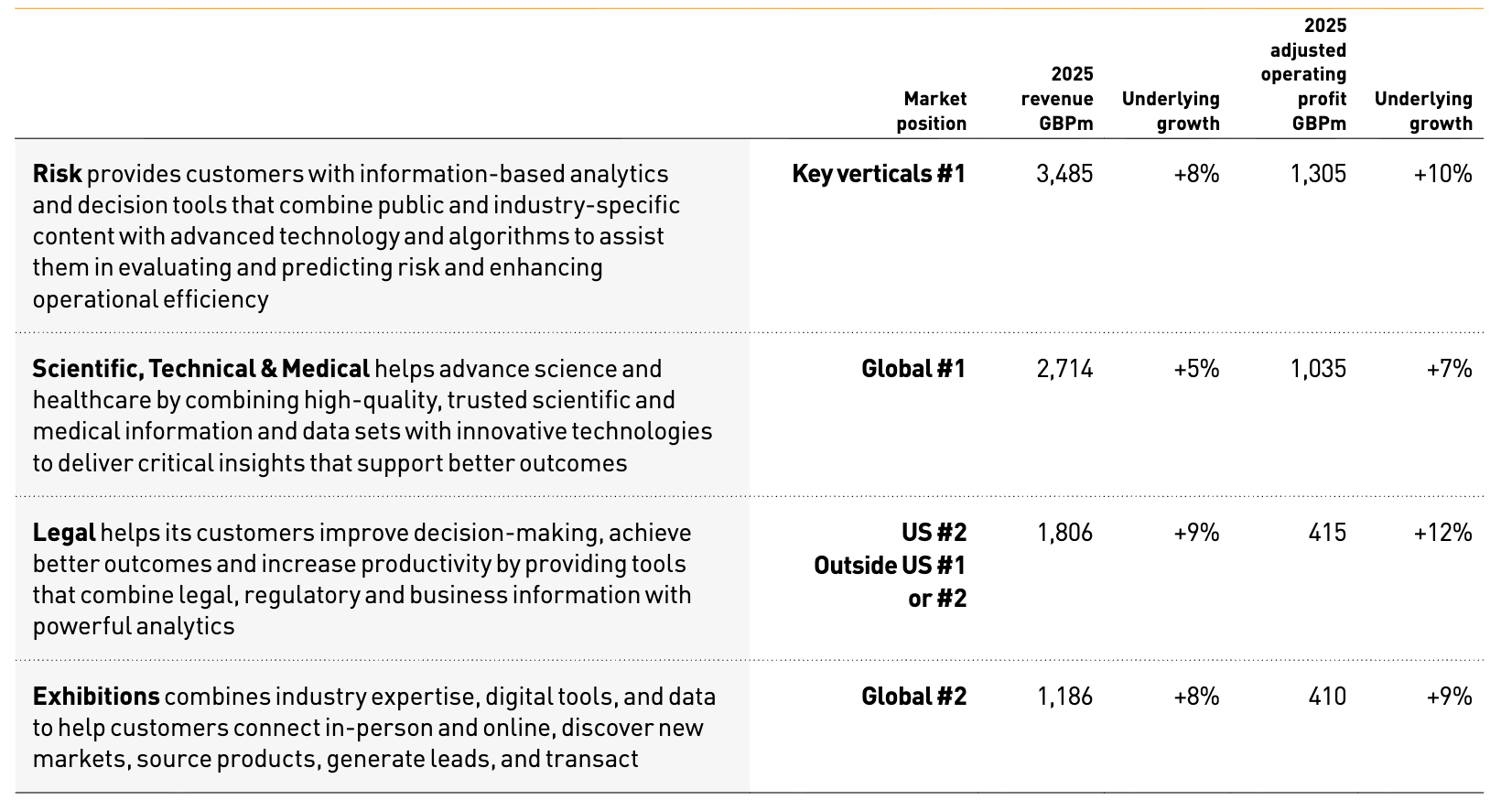
The Scientific, Technical and Medical market segment (to use RELX’s terminology; the rest of us call it ‘Elsevier’) is 28% of RELX revenues and 31% of adjusted operating profit. RELX’s high profit margins are not created entirely from the academic sector: RELX is also generating cash from lawyers, risk managers and exhibitionists (sorry, couldn’t resist).
The sheer scale of RELX is worth noting. RELX employs 37,000 people, of whom more than 12,000 are technologists ($2 billion annual technology spend). 9700 people work for Elsevier, which is 26% of the RELX workforce; it’s not clear whether that figure includes shared services like technology (I suspect it does).
The underlying growth for Elsevier’s adjusted operating profit is higher than for revenue. In other words, revenues are increasing faster than costs, improving profitability.
Nick Luff, the RELX Chief Financial Officer, told investors:
Here you can see the 9% underlying growth in group adjusted operating profit. As Erik [CEO] mentioned, we continue to manage cost growth to be below revenue growth in each business area. As a result, Risk, STM and Legal each delivered underlying profit growth two or three percentage points ahead of underlying revenue growth, while Exhibitions was one point ahead, reflecting event cycling in the year.
You may not approve of the high profit margins of commercial publishers, but everyone should understand that they’re only possible because of significant financial investment into a niche industry.
RELX has a market capitalisation of £43 billion. This means that its owners, which include pension funds and other corporate investors, have £43 billion invested in the company. Since Elsevier contributed 28% of RELX’s revenue, you could say, perhaps, that around £12 billion is invested in Elsevier.
Elsevier incurred costs of around £1.7 billion last year, which included investment to develop new technology and for improving services.
Compare that figure with the recent announcement about Open Research Europe (ORE), the diamond open access journal (database?), which was launched with much fanfare last week:
Backed by a nearly €17 million budget for the period 2026-2031 and co-funded by the European Commission by up to €10 million, the new phase of ORE is set to begin operations as a collectively supported publishing service in the autumn of 2026, with CERN operating the platform.
€17 million over 5 years is like bringing a knife to a gunfight.
Anyway, I digress.
STM segment
OK, so let’s turn our attention to the Scientific, Technical & Medical market segment, also known as Elsevier (coverage starts on page 18 in the annual report, if you want to follow along). Revenues were £2.714 billion (+5% vs 2024) and adjusted operating profit was £1.035 billion (+7% vs 2024).