

Journalology #151: The Midas touch

Hello fellow journalologists,
I’ve almost caught up on the newswires after my summer vacation. Today’s newsletter will summarise some of the announcements and initiatives that grabbed my attention, either because they’re important in their own right or because they’re thought provoking or useful.
Issue 151 of Journalology covers:
Wiley and the Genesis Mission
S2O: lessons from IWA Publishing and EDP Sciences
Nigel, an AI tool for gastroenterologists
Is AI slower, worse, and more expensive?
Do academics need to write research papers?
AI and scientific illustration
Later this week you can expect to receive issue 152 of Journalology (yes, they are like buses), which will focus on the annual reports and quarterly updates released by publishers recently, including Springer Nature, Informa, OUP, and IEEE.
If you missed the last issue of The Jist, which collated the news stories from media outlets in recent weeks, you can read it here:

Wiley Joins U.S. Department of Energy’s Genesis Mission Consortium to Advance AI-Powered Scientific Discovery
Wiley today announced its membership in the Genesis Mission Consortium, the public-private partnership supporting the U.S. Department of Energy's (DOE) Genesis Mission, joining organizations including Nvidia, AWS, Microsoft, IBM, and AMD. Wiley is the only scientific publisher among the consortium's members and has been invited to demonstrate its work today at the Genesis Mission Annual Summit in Washington, D.C.
JB: It’s difficult to keep up with news coming from the White House. Publishers have understandably been focusing on the Office of Management and Budget’s (OMB) proposed revisions to the federal grant regulations, but there have been other recent initiatives that should be on journalologists’ radar too, one of which is the Genesis Mission that’s referred to in the above press release; we’ll come back to that in a bit.
[Over the weekend we learned that a final decision on the OMB proposal is likely to be postponed until after the mid-term elections. Nature ran a story about this important news yesterday. The statement from the STM Association is worth reading too: OMB grant regulation paused by Congress.]
However, there have been other developments that we need to be aware of too. A few weeks ago the US administration released a new report — Science: A New Golden Age — which shouldn’t be confused with the May 2025 Executive Order Restoring Gold Standard Science (all initiatives need to have gold in their title for obvious reasons).
The report has one author: Michael Kratsios, Assistant to the President and the Director of the White House Office of Science and Technology Policy. In his Substack, Holden Thorp, the Editor-in-Chief of Science, provides some valuable historical background for the Kratsios Golden Age report, which follows a similar format to Vannevar Bush’s 1945 presidential report, Science: The Endless Frontier.
Holden writes:
Golden Age starts off with a letter from Kratsios followed by a letter from President Trump. Endless Frontier starts the same way with letters from Bush and FDR. Kratsios then goes on to talk about all the wondrous things that Endless Frontier has enabled and then explains why the current scientific enterprise in American universities has rendered its principles obsolete through ideology and incompetence. The thrust is to turn the reader against the current American academic scientific establishment, which, in Kratsios’ telling, has taken away all the beautiful things that Bush gave us.
On page 67 of the Golden Age report is a section entitled “Rethinking Scientific Publication”, with only one reference in the footnotes: an Astera Institute Substack blog published a year ago:

Hold the word ‘legacy’ from this extract in your memory (more on that later).
Gold is mentioned 53 times in the Golden Age report, but not in the form of “gold open access”, which has fallen out of favour despite its lustrous name. APC price caps are likely on the way, remember.
Kratsios’ New Golden Age will be based on five themes:
Launch and Scale the Genesis Mission
Institutionalize Gold Standard Science
Build Verification Infrastructure at Scale
Accelerate Autonomous Experimentation
Experiment With AI-Native Scientific Institutions
Indeed, a few days after the report was released the initial funding of the first theme, the Genesis Mission, was formally announced, which a Nature news story described as follows:
Some 5,000 teams applied for funding from the Genesis Mission, which the administration billed as a programme “comparable in urgency and ambition to the Manhattan Project” to accelerate US science with AI. At a summit on 22 July, officials announced about 280 winning projects in a first phase of the programme. Teams will apply AI to problems such as improving the US power grid and automating laboratories, and will receive a 9-month grant for between US$500,000 and $750,000. Researchers in these teams can also submit applications for a second phase: a three-year programme involving millions in annual funding.
Needless to say, King Midas would be happy with the naming of one of the prizes:
Under this new vision, individual scientists would be supported by programmes such as ‘golden tickets’, which give grant reviewers the ability to override the decisions of their colleagues to fund high-risk proposals.
Wiley is understandably excited to be the only publisher that’s part of this (allegedly) $5 billion project, but there’s a difficult PR line to tread here as the Genesis Mission — and the administration more broadly — is controversial within academia. After all, this is how Kratsios frames the US university system:
Though our investments in research have grown, scientific productivity has slowed. We have become dependent on a narrow set of legacy institutions. Our incentive structures reward conformity overbold inquiry.
“Legacy institutions” is used a handful of times in the report, with a tone suggesting that legacy is not something to be admired; legacy is used in the form of ‘legacy software’ (something that needs replacing) rather than ‘leaving a legacy’. For example:
The AI revolution, meanwhile, is transforming the conduct of science, and legacy scientific institutions and infrastructure are not ready to take full advantage of this transformation.
This is how Wiley — a ‘legacy publisher’ that generates much of its revenues from ‘legacy institutions’— will contribute to the project:
As a consortium member, Wiley plans to make its research intelligence tools available to researchers at all DOE national laboratories and will offer DOE leadership and industry partners an early look at potential applications at today's Summit. Wiley's planned contribution to the Genesis Mission draws on its editorial networks and domain expertise across the sciences and evidence-linked scientific content that supports provenance and reproducibility, alongside operational support to help integrate these capabilities into laboratory environments.
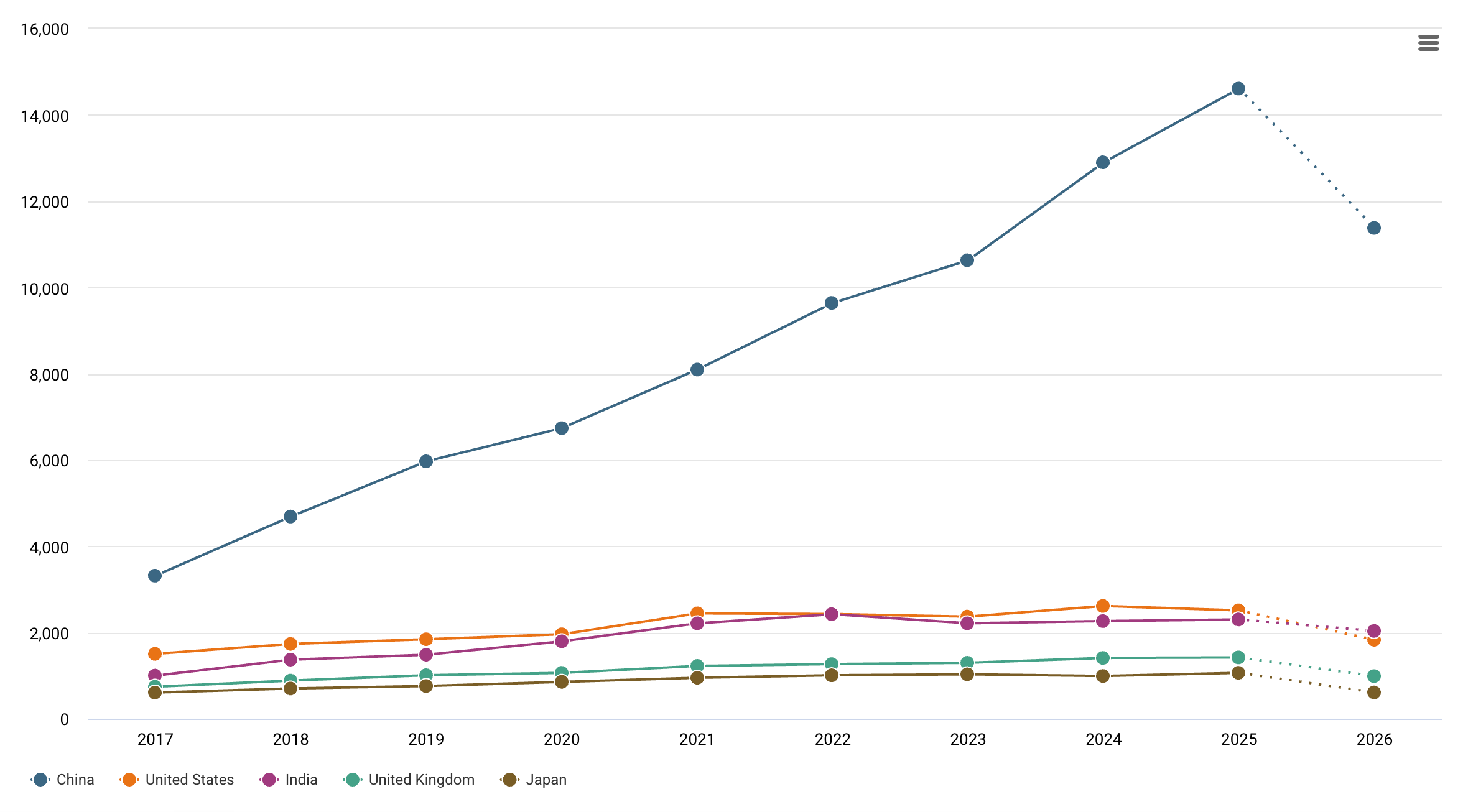
The graph below (from Dimensions) shows the number of research articles classified as ‘Artificial Intelligence’ (using the ANZSRC scheme). As we discussed in the last issue of The Jist, China dominates AI research article output; the USA is playing catch up, at least when it comes to academic AI research (commercial AI is a completely different story, of course).
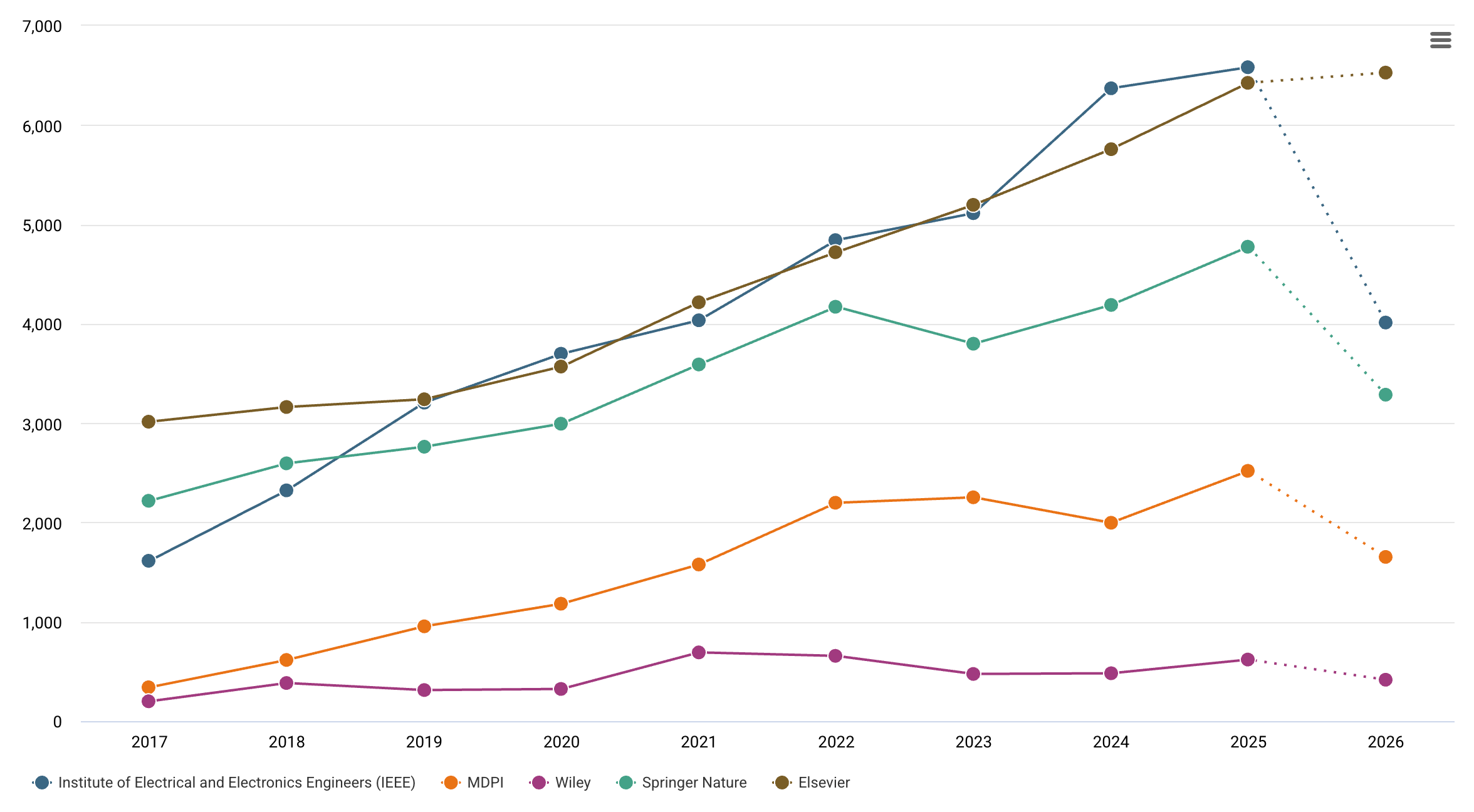
Publishers are competing for market share in this growth area. Elsevier has made significant progress this year and has already published more AI articles in 2026 than it did in the whole of 2025 (see graph below). Wiley publishes fewer AI articles than the other large publishers, but of course the Genesis partnership is based on their internal AI capabilities not the content they publish.
It will be interesting to see how Wiley’s contribution to the Genesis Mission plays out. ‘Legacy publishers’ need to get their voices heard within the corridors of power and this could be a good way to do that. Or perhaps it would be easier just to post a blog on Substack? I suggest the title: “All that glisters is not gold”.