

The Jist: April 29 to May 16
Get the gist of recent news stories, written by journalists, that cover topics related to scholarly communication.

Hello fellow journalologists,
The purpose of The Jist is to summarise how news outlets have been covering scholarly communication.
The stories in this issue of The Jist are presented in reverse chronological order; more recent stories are at the top and older stories are at the bottom.
Before we get to the news, here are links to the newsletters I’ve sent in the past week, in case you missed them:


Hallucinated citations highest in social sciences preprints site
The analysis found that the rates of hallucinated citations varied between different repositories. SSRN ranked first with 1.91% of citations in studies posted there by August 2025 deemed to be hallucinations. ArXiv, a physical sciences repository, ranked second, with 0.39% of its citations incorrect or referring to non-existent papers or researchers. The PubMed Central biomedical-science database had a rate of 0.27% hallucinated citations in peer-reviewed publications. BioRxiv, a preprint server specializing in biological sciences, had a rate of 0.21%.
JB: To my non-expert eye, this preprint looks to be more compelling than the Lancet article that received significant press coverage recently. Here’s a quote from the Retraction Watch story about the Lancet paper (One in 277 PubMed-indexed papers in 2026 shows fabricated references, says analysis):
Fabricated citations in the biomedical literature have increased 12-fold in two years, according to an audit of nearly 2.5 million papers published as a letter to The Lancet today. The analysis of articles indexed in PubMed found that about one in 277 papers published in the first seven weeks of 2026 referenced a paper that didn’t exist. That was a jump from 2025’s rate of one in 458 and 2023’s one in 2,828.
See last issue of Journalology for more analysis.
As scientific fraud proliferates, so do businesses that aim to stop it
The last few years have seen a surge in activity from paper mills, which are shady entities looking to make a quick buck from publishing and spreading fraudulent science. Paper mills sell authorship slots on papers already slated for publication at scholarly journals or offer additional citations in exchange for a fee.
During the same period, multiple efforts have also been launched to identify, flag, and weed out these deceptive practices. Such projects—run by scholarly services firms, academic publishers, and the research community—look for a number of telltale signs that may indicate fraud. Because the area is a hot one, start-ups using technology to address the threats are gaining traction and attracting investment.
C&EN (Dalmeet Singh Chawla)
JB: The number of startups presenting at the STM research integrity conference in London last December was impressive. I’m not convinced that the demand is there for more than a handful of them, though. The large commercial publishers are building their own solutions. Small publishers will struggle to afford multiple research integrity tools. That leaves medium-sized publishers, which is a relatively small market.
Assessing research integrity tools takes time and most of the small or medium-sized publishers simply don’t have the bandwidth to judge which ones best suit their needs.
Elsevier retracts the least and reinstates the most, new analysis finds
By his calculation, Elsevier’s retraction rate was 3.97 articles per 10,000 published. This compared to 5.46 for SAGE, 6.21 for Wiley, 6.50 for Taylor & Francis, 9.06 for Springer Nature, 17.70 for IEEE, 26.82 for PLOS and 283.77 for IOS Press. Readers of Retraction Watch won’t be surprised the highest retraction rate showed up at Hindawi, at 320.02 per 10,000. Wiley acquired the publisher in 2023 and the high number of retractions – including over 11,000 from late 2022 to early 2024 – is “consistent with the mass retractions following Wiley’s acquisition,” Oppenlaender wrote.
Retraction Watch (unsigned)
JB: The preprint was published in February, and so won’t have picked up on the big increase in retractions from Elsevier recently. The image below is taken from this page, which searches for “Retraction notice” on Science Direct.
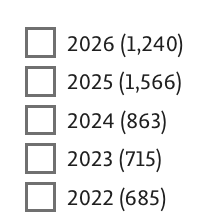
The preprint’s author, Jonas Oppenlaender, did not include some of the largest publishers, such as Frontiers and MDPI, because these publishers retract fewer papers, on average, and so didn’t make it onto the top 10 list.
A high retraction rate reflects a willingness to correct the scholarly record, which should be applauded (while acknowledging that prior quality control processes missed problematic papers).
Elsevier vs Meta: first science publisher sues over scraped research papers
Elsevier — which publishes thousands of journals, including Cell and The Lancet — was part of a class-action lawsuit filed on 5 May against technology company Meta and its chief executive Mark Zuckerberg in the Southern District of New York. Also named as plaintiffs on the lawsuit are book-publishing giants Hachette and Macmillan, and the US fiction author and lawyer Scott Turow. The publishers allege that Meta obtained and reproduced copyrighted works in developing its large language model (LLM) Llama.
Nature (Elizabeth Gibney)
JB: C&EN also covered this story and approached other academic publishers for comment (As Elsevier sues Meta over AI, other scholarly publishers are keeping a watchful eye).
Meanwhile, Times Higher Education ran: ‘Open season’ on scholars’ rights if Elsevier loses Meta fight.
Academics may find themselves in the unexpected position of cheering on Elsevier in its legal battle with Meta because victory for the Facebook owner would signal “open season” on scholars’ rights to control how their work is represented, legal and publishing experts have said.
As researchers aim for universal AI disclosure guidelines, the devil is in the details
Seghers and Weaver hope to produce guidelines for AI disclosure specific enough to provide practical guidance, but also broad enough to cover future eventualities, including end-to-end hypothesis generation, research, and reporting by AI systems. “Some say it’s naïve,” Seghers acknowledges, “but mapping the problem is something already.”
Science (Nicola Jones)
JB: This news story covers some of the main themes from the World Conference on Research Integrity (WCRI), which was held in Vancouver last week.
Nicola also published Gotcha! Odd language mistakes may help identify fake papers in Science.
Tamarinde Haven, a social scientist studying research integrity at Tilburg University, notes the approach is probably catching mistakes originally made by humans rather than by a generative artificial intelligence programs, which are less prone to spelling errors. That means it is likely picking up “old-fashioned” fakes, which are presumably becoming less common. So, the technique will likely become less effective over time, she says. [James] Heathers agrees. “Every detection model goes out of fashion.” But if a strategy works, he argues, it should be used until it stops working: “You find the bug, you kill the bug.”
And also: AI agents may be skilled researchers—but not always honest ones.
But in a presentation at the World Conferences on Research Integrity here today, Shah reported that both systems engaged in acts that aren’t acceptable in research, including making up data and “p-hacking”: running an experiment multiple times but only reporting the best outcome. (The team’s results were previously posted as a preprint on arXiv.) The misbehaviors weren’t obvious and required a lot of sleuthing to track down, suggesting AI-assisted studies might fall victim to such problems without their authors’ knowledge.
Rising Retraction Rates: A Symptom of a Strained System
Although he respects the work of people rooting out examples of scientific fraud, Hanson said that focusing on retractions is a losing game. “Hunting down all the bad actors and retracting all the individual articles doesn't help because it's like trying to play whack-a-mole except the molehill is the size of Mount Everest,” he said. “Addressing the fact that there's an entire subterranean culture underneath that hill is going to be more challenging, but also more permanent as a solution.”
The Scientist (Shelby Bradford)
Early-career researchers do more ‘disruptive’ science than veterans
Experienced researchers are less likely to produce ‘disruptive’ science than are those just starting their careers, finds an analysis of the scientific papers published by 12.5 million researchers over 60 years. The authors discovered that older researchers are better at connecting existing ideas to produce new knowledge than are younger researchers. But those with more experience are worse at achieving massive breakthroughs that overhaul, or disrupt, entire fields of research — as happened with innovations such as the discovery of the structure of DNA.
Nature (Mariana Lenharo)
CDC leader calls for new journal to ‘elevate scientific rigor’
In a 30 April op-ed in The Washington Post, Bhattacharya changed tack. “Recognizing that MMWR does not subject its articles to formal external peer review and that it serves as a bulletin representing the voice of the CDC, I issued one of my first directives as acting director, calling for the development of a peer-reviewed journal, in addition [sic] MMWR, to complement it and elevate scientific rigor across all CDC publications,” he wrote. Epidemiologist Charlotte Kent, who was editor-in-chief of MMWR when she retired in January 2025, notes that CDC already publishes two journals that use external peer reviewers, Emerging Infectious Diseases and Preventing Chronic Disease. Those journals could handle content that now goes into MMWR, Kent says. “I don’t see what would be the benefit of starting a new journal.”
Science (Jon Cohen)
JB: There must be something about having the initials JB that makes us want to launch new journals. You can read the other JB’s opinion piece in The Washington Post here: Jay Bhattacharya: The CDC is committed to upholding scientific rigor.
‘The era of norms is dead,’ so should peer reviewers be paid?
Johan Rooryck, a former executive director of the Coalition S open access group, told RPN that paying reviewers is “a very bad idea”. He argued that paying peer reviewers “further monetises…the publishing system into distinct, payable, commoditised units”, whereas peer review should be “a collaborative moment, not a transactional one”. Rooryck also warned that payment “practically invites abusive practices in the form of ‘reviewing farms’ that will use thinly disguised artificial intelligence-generated reviews for money”, with particular risks for researchers in low- and middle-income countries.
Research Professional News (Fiona McIntyre)
JB: This week Inside Higher Ed also covered the same topic (Will Paying Reviewers Ease the Peer Review Crisis?) and, like RPN, led with quotes from Jonas Kunst, who founded Advances.in. You may remember from a couple of Jists ago that Times Higher Education ran Can journals that pay peer reviewers succeed?, which also focused on Advances.in. In that issue of The Jist I wrote:
I covered the launch of Advances.in back in issue 14 of this newsletter. Their tagline is “reinventing academic publishing”. 50 papers published over a 4-year period suggests that the process is going rather slowly.
I can’t help but wonder if Jonas Kunst is trying to turn things around by pitching multiple news outlets for coverage of his work. Three very similar news stories in as many weeks seems rather odd to me.
F.D.A. Blocked Publication of Research Finding Covid and Shingles Vaccines Were Safe
Officials at the Food and Drug Administration have blocked publication of several studies supporting the safety of widely used vaccines against Covid-19 and shingles in recent months, a spokesman for the Department of Health and Human Services confirmed. The studies, which cost millions of dollars in public funds, were conducted by scientists at the agency, who worked with data firms to analyze millions of patient records. They found serious side effects to be very rare.
The New York Times (Christina Jewett)
First AI tool to detect suspicious peer reviews rolled out by academic publisher
In an analysis of around half a million peer-review reports for manuscripts submitted to the IOPP between 2020 and 2025, the AI tool identified nearly 2,500 reports that had at least 60% overlap with former reviewer reports, of which 785 reports had at least 80% overlap. Of the flagged cases, 89 were exact duplicates. The IOPP is rolling out the tool across all its journals, the publisher announced on 5 May.
Nature (Miryam Naddaf)
AI Slop Is Flooding Academic Journals. A Top Journal Measured It
The good news is that the editorial process at Organization Science is still filtering effectively. Only 3.2% of manuscripts scored at 70% or higher usage of AI receive a revise and resubmit, compared with 11.9% for low AI papers. Published articles remain overwhelmingly human generated. The editors are catching the bad work. There is a significant human cost, however. The journal doubled its deputy editors from six to eleven and nearly doubled its senior editors from roughly 30 to 60. All of this is volunteer labor, unpaid academics donating time to maintain scientific quality. When those academics are weeding out AI slop they are not using their time to teach classes, conduct research, or serve their professions.
Forbes (John Drake)
JB: The Nature news team also covered this study, plus some other recent ones, in How much of the scientific literature is generated by AI?
Why preprint servers are increasing moderation — and what that means for researchers
Preprint servers are not dumping grounds for manuscripts, says Chtena, who adds that the impression she got from her interviews with repository managers and moderators is that they “try to set the bar as low as possible” when it comes to moderation, but have had to become more discerning as the information ecosystem has become more polluted. There is no perfect amount of moderation, nor one rule book that Chtena, Fleerackers or others point to as representing best practice. Ultimately, each platform and moderator is serving their community as best they can under the circumstances, says Chtena. “I saw a tremendous amount of care put into moderation and how it is set up.”
Nature (Jackson Ryan)
And finally…
News stories about research integrity challenges, often caused by AI, dominate this newsletter. So you may be grateful to meet the academics refusing to use generative AI.
When Possingham pledged to not use AI unless otherwise advised, he said that many of his peers were supportive. However, there were some vocal critics. “People were more or less saying in their own way, you’re a Luddite and the world’s moving on,” he recalls. And being a researcher who abstains from genAI can feel a bit similar to being a black sheep.
No AI was used in the creation of this newsletter. Why? Because the journey is more important than the destination. That’s how we learn and get better at our craft.
Until next time,
James
P.S. Please hit the ‘like’ button (shaped like a heart) at the bottom of this email if you enjoyed The Jist. The Substack promotion algorithm responds to these signals, you see. Thank you for your support.
"No AI was used in the creation of this newsletter. Why? Because the journey is more important than the destination. That’s how we learn and get better at our craft." A 100% agree with this quote. If only more researchers and students thought about it...
That section on the “reinforcing cycle of mistrust” really stood out to me because it feels like many of the other stories in this issue quietly orbit the same problem from different angles.
Whether it is AI-assisted review, integrity screening, reviewer fatigue, publication pressure, or debates around publisher value, the underlying tension often comes back to confidence in the evaluation process itself.
From an editorial perspective, authors are no longer only trying to get published. Increasingly, they are trying to anticipate how trust, credibility, and legitimacy are being assessed across systems that have become far more complex and operationally strained than most researchers fully realize.
That gap between how publishing is imagined by authors and how it actually functions behind the scenes probably explains more friction than we acknowledge.