

MDPI and Frontiers: 2025 in review

Hello fellow journalologists,
This is the third in a series of essays covering the annual reports of the large academic publishers. In case you missed them, here are links to the two previous articles, which covered Elsevier and Springer Nature:


Today’s analysis includes two publishers that have a lot in common. Both MDPI and Frontiers were founded by former academics who saw an opportunity to make research freely available via open access (and generate life-changing wealth, too). These two companies have disrupted the academic publishing industry over the past 5+ years; it’s worth examining their recent performance and likely future direction of travel.
Both companies are privately held and do not publish their financials. So today’s analysis will primarily focus on non-financial indicators. However, since both publishers generate most of their income from publishing journal articles, their article output is likely to have a strong correlation with their revenues.
Setting the scene
MDPI is the more successful of the two, if article growth and volume is your definition of success. The graph below shows the number of research articles published each year (excluding preprints) up until 2024, according to Dimensions (Digital Science). The output of both publishers increased rapidly until a peak in 2022 and then fell in 2023 and 2024.
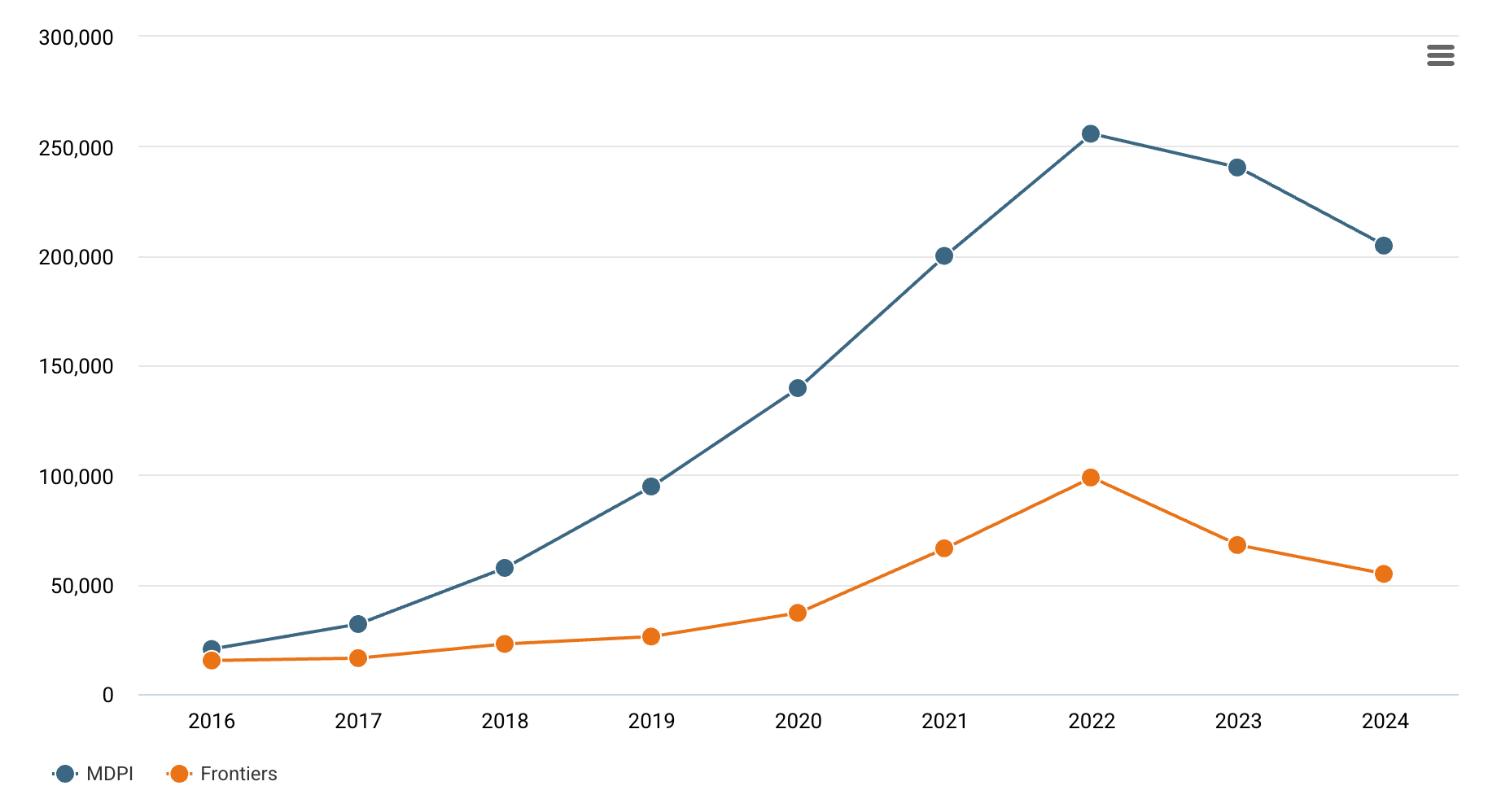
MDPI published 50,000 fewer research articles in 2024 compared with 2022; Frontiers output fell by slightly less. We don’t know what the average revenue per article would have been for those lost articles; a lot depends on how generous their waiver policies were and whether the ‘lost’ papers would previously have been given APC waivers. (Back in 2022, the average “waived share of total APC” was 36% for MDPI).
If the average revenue per article was $1500, perhaps revenues were $75 million less in 2024 than 2022 for each publisher. That’s a guesstimate, though. Whatever the true number is, it likely had a material effect on their financial bottom line.
This is presumably one reason why the Frontiers management team felt that they had little choice but to make 600 colleagues redundant in January 2024, reducing the size of the team from 2000 people to 1400.
Author pays business models allow revenues to scale quickly, unlike institutional subscription deals, which are often locked in for a number of years. That’s beneficial when times are good, but incredibly problematic when article output drops suddenly.
MDPI, in particular, is well known for publishing papers quickly. If submissions dry up, or if the publisher needs to hit the brakes because of research integrity issues, revenues can drop fast. This makes the business model far less resilient than a traditional annual subscription business, and is presumably why both companies have been signing institutional open access publishing deals.
In short, after two years of decreased output, 2025 was an important year for both MDPI and Frontiers. Would they follow the same trajectory as PLOS and decline slowly over time? Or would they manage to turn the tide and recover some of the ground that had been lost?
