

The Jist: Five ways to...
The Jist summarises journalist-written content for journalologists, providing readers with the gist of recent news stories in scholarly publishing. Paid subscribers to Journalology also receive an in-depth analysis of recent publishing industry developments, sent mid-week.
Hello fellow journalologists,
I started writing Journalology in August 2022. By October 2025, when I migrated the newsletter to Substack, Journalology had around 5500 subscribers. Growth had happened slowly and steadily over a period of 3 years primarily by word of mouth; most of the readers worked in academic publishing or adjacent fields.
Last week the Journalology newsletter hit the 8000 subscriber mark; 2500 new subscribers have signed up to Journalology in the past 4 months. Journalology is now ranked #10 in the Bestseller in Science list and so the newsletter gets more visibility on the Substack platform as a result.
I strongly suspect that the majority of the 2500 recent subscribers do not work for academic publishers. I want to help this broader range of people to discover stories that help them to understand the challenges that scholarly publishing currently faces.
I’m committed to providing a free version of the Journalology newsletter that complements the paid analysis that gets sent out mid week. The free newsletter is now called The Jist, an imprint that I’ve used before.
This should help to differentiate the free newsletter (The Jist) from the in-depth analysis that I provide in the mid-week, full-length Journalology newsletter, which goes to paid subscribers. The Jist will be sent on Sundays, probably biweekly, depending on how much news there is to cover.
News headlines
Career effects of preprints get mixed reviews from biomedical researchers
Nearly half of biomedical scientists worry preprints could spread shoddy research and misinformation, according to a new survey that could help explain why the life sciences have taken up the publishing practice more slowly than some other fields. The survey is one of the largest to date to examine views of life sciences researchers on the practice of placing non–peer-reviewed manuscripts on public servers. The results, posted this week on the bioRxiv preprint server, also reveal that researchers on average do not believe publishing preprints enhances their career advancement. But many acknowledge benefits, such as spreading their findings more quickly than peer-review journals do and helping them find collaborators.
Science (Jeffrey Brainard)
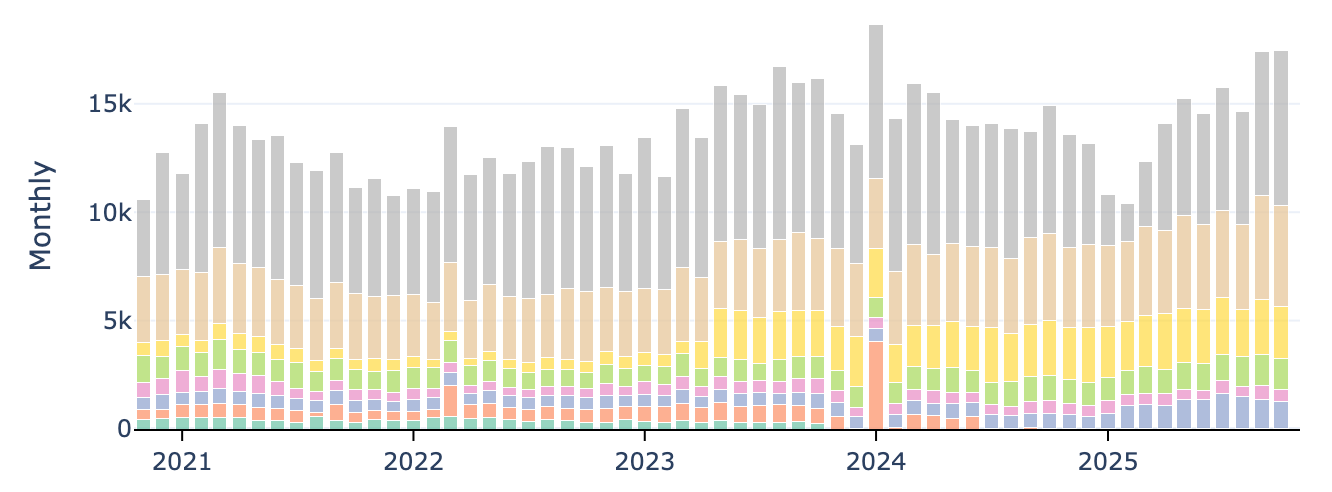
JB: I’ve included this graph of preprints in Europe PMC before, but here it is again because it tells an important story: monthly preprint output in the biomedical sciences is not growing, despite the publicity and promotion that preprints have received in recent years.
Richard Sever, who is Chief Science and Strategy Officer at openRxiv, perhaps unsurprisingly provides a more positive outlook on preprints, as reported in the Science story:
But concerns over quality may be based more on researchers’ impressions than evidence, Sever says, noting that bioRxiv and medRxiv reject submissions that don’t use the scientific method or that pose obvious risks to public health. Preprinting a fraudulent manuscript exposes it to more scrutiny than if it appeared only in a journal, he adds. “If you get a reputation for being the person who always puts up stuff [on preprint servers] which doesn’t have complete data and is shoddy, then you’re done in academia.” What’s more, some 80% of preprints eventually appear in peer-reviewed journals. And despite their quality checks, journals publish problematic papers, he says.
Major Chinese funder to stop paying fees for 30 pricey open-access journals
In a challenge to open-access publishers, the Chinese Academy of Sciences (CAS), the world’s largest research institution, has told its researchers it plans to stop paying to publish their papers in dozens of international free-to-read journals it regards as too expensive. High-profile, high-fee journals affected include Nature Communications, Cell Reports, and Science Advances. CAS, which employs more than 50,000 researchers across some 100 institutes, has yet to publicly announce the new policy, expected to take effect on 1 March. Observers say it is likely aimed at controlling costs and perhaps boosting China’s own journals.
Science (Jeffrey Brainard)
JB: I wrote about this story in Thursday’s newsletter. I also covered the proposed NIH price cap (which is expected imminently) 8 months ago.
Five ways to spot when a paper is a fraud
Unfortunately, the current deluge of bad papers is unlikely to subside without massive systemic changes. And advances in AI and other technologies are only making fraudulent papers harder to catch. But that doesn’t mean that it’s a waste of time to stay on the lookout. The scientific community, Richardson says, is like a nature reserve — something to be protected and maintained, but also enjoyed. You might not walk through the reserve with the intention of keeping it clean, he says, but “it doesn’t hurt to pick up trash every now and again”.
Nature (Stephanie Melchor)
JB: This news feature provides tips from research integrity sleuths on how to sniff out dodgy papers.
AI agents are ‘aeroplanes for the mind’: five ways to ensure that scientists are responsible pilots
AI research agents will look different in each field, but they should follow the same basic rules: results should be traceable, methods verifiable and responsibilities assigned clearly. Establishing those rules will require coordination between scientific societies, funders, journals, public research infrastructures and the AI labs building today’s models. The goal is a shared public–private framework for interoperability — for instance, common standards for logging agent decisions so that an analysis run in one lab can be audited or reproduced by another.
Nature (Dashun Wang)
JB: I tried to find five news stories where Nature used “five ways” in the title, but could only find two in the past few weeks (see above).
Censorship and safety concerns cloud China’s plans to host science journalism conference
Proponents of holding the meeting in China hope it will assist science journalists there and help connect international reporters to the country’s scientists. But others worry discussion of certain topics will be suppressed, and that some journalists will not be able to safely travel to a country that regularly detains members of the press. “It’s insane that you would pick the world’s largest prison for journalists to hold a science journalism conference,” says Jackson Ryan, president of the Science Journalists Association of Australia, who presented that country’s bid.
Science (Anthony King)
A medical journal says the case reports it has published for 25 years are, in fact, fiction
A Canadian journal has issued corrections on 138 case reports it published over the last 25 years to add a disclaimer: The cases described are fictional. Paediatrics & Child Health, the journal of the Canadian Paediatric Society, has published the cases since 2000 in articles for a series for its Canadian Paediatric Surveillance Program. The articles usually start with a case description followed by “learning points” that include statistics, clinical observations and data from CPSP. The peer-reviewed articles don’t state anywhere the cases described are fictional.
Retraction Watch (Kate Travis)
JB: This journal, currently published by Oxford University Press, has been publishing fake clinical case reports for 25 years without making it clear that the cases were entirely fictitious. The journal is indexed by Web of Science and PMC:
The journal also submits the full text of its articles to PubMed Central, including the case studies. The versions on PubMed Central also do not bear any indication the case reports are fictional.
Hey ChatGPT, write me a fictional paper: these LLMs are willing to commit academic fraud
All major large language models (LLMs) can be used to either commit academic fraud or facilitate junk science, a test of 13 models has found. Still, some LLMs performed better than others in the experiment, in which the models were given prompts to simulate users asking for help with issues ranging from genuine curiosity to blatant academic fraud. The most resistant to committing fraud, when asked repeatedly, were all versions of Claude, made by Anthropic in San Francisco, California. Meanwhile, versions of Grok, from xAI in Palo Alto, California, and early versions of GPT, from San Francisco-based OpenAI, performed the worst.
Nature (Elizabeth Gibney)
JB: I tend to use Google Gemini because it’s included in my Google Workspace subscription, but I plan to experiment with Claude soon, not least because Anthropic is standing up for itself against the US government.
Chemist nears three dozen retractions for image duplication, self-citation and more
In at least eight of the retractions, named problems include citation manipulation. By the time one paper went from submission to publication in Heliyon, the authors had added 28 citations that were “not relevant to the topic of the paper and benefit authors,” including Louis, according to the retraction notice. In another Heliyon paper, between submission and publication, self-citations for Louis increased from seven to 38 and from two to nine for Benjamin. And in a third Heliyon paper, self-citations jumped from one to 14 for Louis and from two to 11 for Benjamin.
Retraction Watch (Lori Youmshajekian)
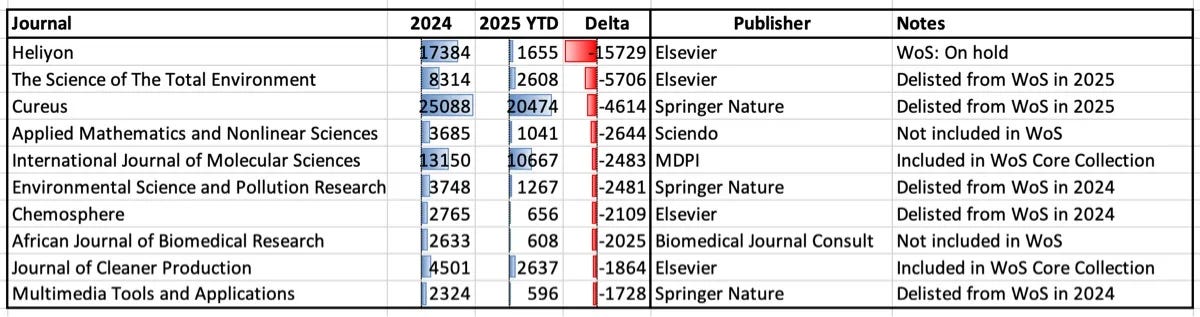
JB: Heliyon is a Cell Press journal published by Elsevier and has been issuing retraction notices at scale in recent months (there were 582 retractions when I wrote this LinkedIn post a month ago; there are now 858 retraction notices issued by Heliyon).
The table below shows the 10 journals that shrank the most in 2025 compared with 2024 (taken from this Journalology newsletter from December 2025). Heliyon tops the chart.
This AI can improve your peer review — and make it more polite
About 24% of the reviewers who received AI feedback revised their reviews, making their comments on average 80 words longer as they added more specificity. A set of human specialists who evaluated a subset of the revised reviews judged 68% of them to be better than the originals. Authors whose reviews had received AI feedback wrote longer rebuttals than did those whose hadn’t, and reviewer responses to those rebuttals were also longer. Zou interprets these lengthier responses as higher engagement in the process.
Nature (Nicola Jones)
JB: Politeness is a good thing. It’s a shame some people need a machine to help them to treat colleagues respectfully.
Will AI Help or Hinder Scientific Publishing?
Meanwhile, scientific publishing is confronting AI in another realm: peer review. As an editor, Perlis has noticed that, since the pandemic, it has gotten more difficult to recruit reviewers willing to evaluate manuscripts, as researchers became more burnt out and more began declining review requests, or simply did not respond to editors’ calls. Allowing researchers to use AI could “broaden the pool of people who can contribute to science in some way,” he said. (A 2025 survey of about 1,600 scientists by the publishing company Frontiers found about half reported using AI to help conduct peer review.)
Undark (Claudia López Lloreda)
Is authors’ treatment by publishers getting worse?
But publishers are generally wary of speaking publicly about the friction that can arise between authors, reviewers and editors. Times Higher Education approached a number of leading university presses and academic publishers, but most – Cambridge, Chicago, Oxford, MIT, Princeton and Routledge/Taylor and Francis – failed to reply or opted not to be quoted.
Times Higher Education (Matthew Reisz)
JB: Publishers are often vilified on social media and some news outlets also enjoy a pile-on. I can understand why people working at publishers are reluctant to engage; I was too when I had a salaried job. It’s important to do so, though, otherwise the narrative will continue to be negative and one-sided.
The Value Challenge in Scholarly Publishing
Yet many in academia continue to view publishers as gatekeepers who benefit disproportionately from academic labor while offering limited recognition or return. At the same time, publishers frequently underestimate how undervalued and overburdened authors and reviewers feel, as demands on their time continue to grow. The result is a reinforcing cycle of mistrust. Scholars criticize, publishers defend, and both sides retreat into increasingly entrenched positions.
The Scholarly Kitchen (Ashutosh Ghildiyal)
JB: This opinion piece explores some important issues that should be discussed more. Most of the stories included in today’s newsletter are “bad news” stories, which provide a skewed view of the publishing industry.
The thousands of people working in academic publishing make many positive contributions to the research enterprise; those ‘stories’ don’t make good copy, unfortunately.
And finally…
Pokémon turns 30 — how the fictional pocket monsters shaped science
The world of Pokémon has also been used to expose dodgy practices in academic publishing. As well as playing Pokémon Go in his spare time, entomologist Matan Shelomi at National Taiwan University in Taipei used Pokémon to raise awareness about predatory journals, which are “just a scourge on academia”, he says. In 2019, he began writing dozens of fake papers using with made-up references and fictitious co-authors including characters from Pokémon such as Professor Samuel Oak and submitted them to journals that he suspected to be predatory. “Any predatory journal that sent me spam e-mail, I would reply with one of these fake submissions,” he says.
If you know any kids who are interested in Pokémon, this story is worth reading. My 8-year-old is a taxonomist in training.
Until next time,
James