

Wiley acquires Emerald: feeling green?

Hello fellow journalologists,
Earlier this month Wiley announced that it had acquired Emerald Publishing from Cambridge Information Group (CIG) “in an all-cash transaction valued at £337 million, or USD 452 million.”
In this newsletter I’ll talk you through why this acquisition is important and what it means for the wider publishing industry.
Other publishers will likely have been invited to bid for Emerald. Are they feeling green with envy at Wiley’s acquisition, as some were when Wiley acquired Hindawi 5 years ago? Or will Wiley end up feeling green around the gills as it did a few short years after the Hindawi acquisition?
Let’s delve into the numbers and try to read the (green) tea leaves.
Emerald: the backstory
Emerald is a UK-based publisher founded in 1967 by academics from the University of Bradford School of Management; its main editorial focus continues to be on topics related to business, finance and management.
One of the founders, Keith Howard, took full control of Emerald in 2003 and in June 2022 Emerald announced that it had been acquired by Cambridge Information Group (CIG) for an undisclosed sum. The 2022 press release noted:
Cambridge Information Group is a family-owned, mission-led investment firm with a history of long-term investments in education, information, and software companies. During CIG’s multi-decade ownership of ProQuest, the business grew rapidly through investments in new products and multiple strategic acquisitions. CIG’s acquisition of Emerald builds on their deep experience in the higher education industry, with real ambition for long-term growth of the business.
The bold highlights are mine: the recent news that Wiley has acquired Emerald just 4 years after CIG bought it is perhaps surprising, although market consolidation is a theme that we return to repeatedly in this newsletter.
Emerald’s journal portfolio
Last year, according to Dimensions, Emerald published ~22,600 research and review articles1 in nearly 500 journals along with “8,000 book titles, and an extensive archive of case studies and backfile content”. The focus of this analysis is firmly on the journals portfolio.
Emerald was the 19th largest publisher by article output last year, similar in size to Cambridge University Press, PLOS, or the American Physical Society. Wiley, by contrast, published over 10 times as many articles as Emerald last year.
The other recent significant acquisition was OUP’s purchase of Karger at the end of 2025: Karger published 4600 articles in 2025 in 95 journals, so Emerald is around five times the size of Karger and represents a more significant acquisition and consolidation than Karger’s sale did.
You can read my analysis of the Karger acquisition here, if you missed it:

Business models
Emerald primarily generates revenues from its journals via institutional library sales. As you can see in the table below, only 7% of its articles were published in fully open access journals (“Gold”) last year, with another 6% published open access in hybrid journals.
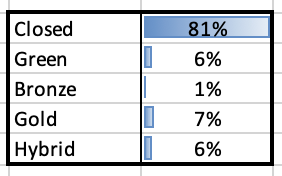
That mix is rather unusual for a publisher these days; the high proportion of subscription content is important to bear in mind when we consider why Wiley — which, remember, acquired the fully open access publisher Hindawi for $298 million five years ago — decided to buy Emerald, a subscription business, for $452 million.
Not so long ago publishers were going all-in on open access; now the subscription model seems to be making a resurgence, with research funders looking to reduce open access costs and with AI companies paying to license subscription content.