

Springer Nature: 2025 in review
Part 2 of a series of newsletters exploring 2025 annual reports
Hello fellow journalologists,
A few weeks ago I dissected the RELX / Elsevier annual report, the first in a series of articles looking at the large commercial publishing companies’ performance in 2025. If you missed it, you can read it here:

The introduction to the annual reports series contains a high level view of the growth of the largest publishers in recent years:

The focus of today’s newsletter is Springer Nature, which is a much smaller business than RELX (£1.7 billion revenue compared with £9.6 billion) primarily because it’s much less diversified: unlike RELX, most of Springer Nature’s revenues and profits come from academic publishing.
The purpose of these deep dives is to help publishing professionals, and other interested readers, to better understand the corporate behemoths that have such an influential role in academic publishing. I’m writing these articles with my younger self in mind; I’m attempting to create a resource that I would have found educational when I was at the start of my career. Hopefully, experienced readers will learn something useful from this analysis, too.
Springer Nature: the story so far
Before we dive into the annual report, I’d like to briefly remind you of Springer Nature’s corporate backstory as it will help us to put the 2025 annual report into context.
As a recap, Springer Nature was formed in 2015 from the merger of two companies: ‘Springer Science + Business Media’ and ‘Macmillan Science and Education’. The two shareholders for the new company were Holtzbrinck Publishing Group (53% holding; a German family-owned business) and BC Partners (47% holding; a private equity firm). The new company, Springer Nature, was thought to be worth “more than €5 billion”, according to a Financial Times report from 2015. BC Partners had paid €3.3 billion for Springer Science a few years before, in 2013.
Private equity firms, like BC Partners, invest in businesses with the goal of selling them at a higher valuation further down the line. The primary objective for the newly formed Springer Nature was to initiate an IPO (Initial Public Offering), the process by which a privately held company is listed for public sale on a stock market. That way, BC Partners could sell its shares and exit the business.
After multiple failed attempts, which I won’t recount here, the IPO eventually went through on 4 October, 2024.
By the end of November 2025, 14 months after the IPO, Holtzbrinck owned 50.6% of the company and BC Partners’ private equity holding dropped from 47% to to 34.8% (source); the remaining shares are now held by other investors.
BC Partners will need to sell all of its shares in the fullness of time, as it will be obliged to return the capital to the equity fund’s investors. However, to date BC Partners has only sold around a third of its initial holding, 19 months after the IPO.
It’s not difficult to see why BC Partners has not rushed to an early exit. The share price at the point of the IPO in October 2024 was €24; reached a highpoint of €27 at the end of 2024; and it fell to a low of €15 about a month ago. The price rebounded a little after the publication of the annual report in March.
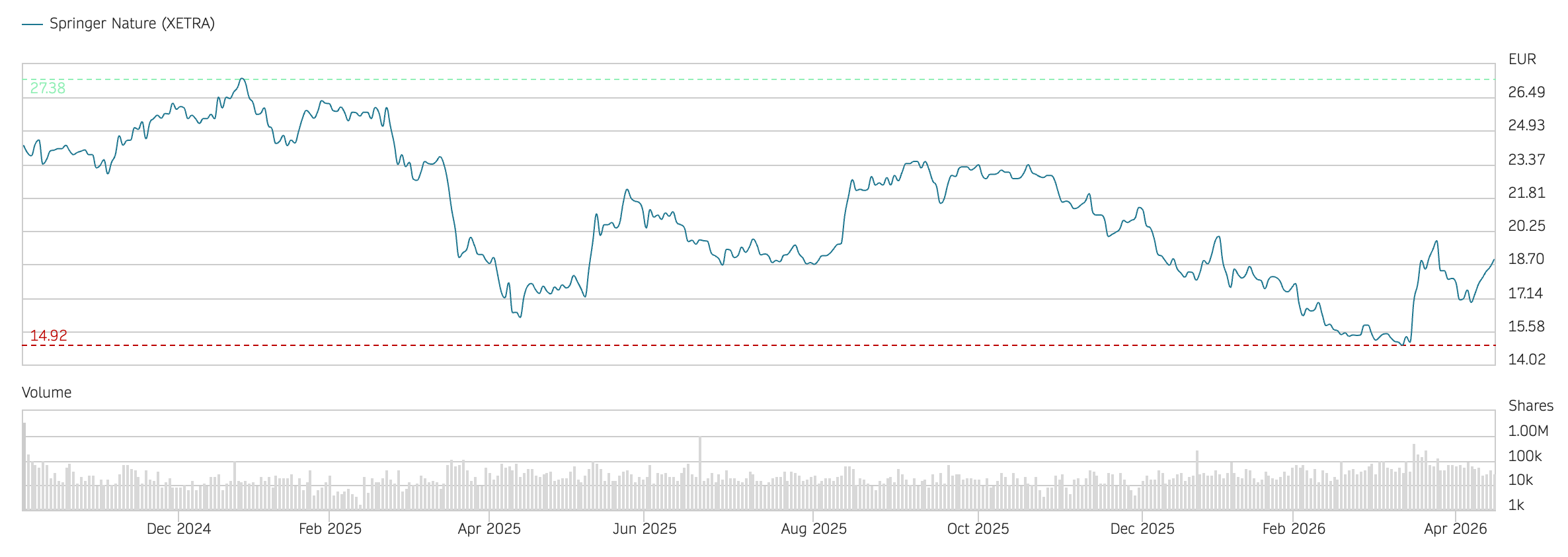
It’s worth remembering that the stock prices of all publishing companies have taken a battering recently because of the perceived threat of AI. For example, the total value of the RELX shareholders’ investments dropped by £13 billion between January 1 and Dec 31, 2025, or £27 billion if you extend the period through to the end of February 2026. It’s recovered a little since then.
The academic community is obsessed with publishing companies’ profitability. However, it’s worth noting that the owners of Springer Nature saw the value of their investment almost halve between December 2024 and March 2026 (i.e. from roughly €4 billion to €2 billion). Yes, the shareholders will receive a dividend payment of €165 million off the back of profits generated in 2025, but the value of their investment dropped by £2 billion in just over a year.
Viewed another way, BC Partners paid €3.3 billion for Springer in 2013 and at the end of 2024, at the high point of the share price, their shareholding in Springer Nature was probably worth around €1.9 billion.
I’m not trying to defend the high profit margins of corporate publishers; the market’s dynamics make it possible for commercial publishing companies to be far too profitable and the likes of RELX have seen strong share price growth over decades; the recent strong downturn is highly unusual.
However, I do want to make the point that people who complain about high profit margins often forget that:
(1) Profit is generated from (significant) financial investment
(2) The value of that investment can go down (a lot) as well as up
(3) New and improved products and services are only possible because of access to large amounts of capital
In other words, financial risk sits alongside reward; the latter is only possible because of investment of capital.
These simple facts are often forgotten by academics who want to ‘take back control’ of publishing. That’s a noble desire (when I was young and naive I left Elsevier in 2004 to join PLOS for exactly this reason) but would need huge financial investment to make happen or a massive disruption by a new technology, for example AI.
Springer Nature Group financial performance
I want to focus most of this newsletter on the Research division of Springer Nature, and in particular on the journals group. But first let’s take a quick look at Springer Nature as a whole.
One important part of Springer Nature’s recent history is that it’s been highly leveraged: the ratio of its debt to earning power was high. This was one of the main reasons why the IPO struggled to get over the line initially; the high levels of debt made the company less attractive to potential investors.
Why was the debt so high? Buying a business is a bit like buying a house: purchasers put down a deposit and take out a bank loan (like a mortgage) to cover the rest.
Springer was owned by a series of private equity houses before being acquired by BC Partners in 2013, which collectively chose to keep the debt levels high. This made an IPO more challenging and so in recent years Springer Nature has been using some of its profits to pay off bank loans.
For example, last year Springer Nature paid off €400m from its loans and now owes €1.2 billion, reducing its leverage to a 1.7 multiple (in 2021 Springer Nature had €2.3 billion of debt and the ratio of debt to profit was a 3.6 multiple). So the company has cut its debt in half over the past 5 years by paying off loans.
This is important because it means it will be able to negotiate better financial terms (lower interest rates) for its remaining loans, as it will be considered a less risky proposition by lenders. This frees up cash for dividend payments, share buybacks, or for investments.
It also means that more cash will be available in the coming years for mergers and acquisitions (M&A), as less money is needed for interest payments or for debt repayments. One of the financial analysts on the investors’ call asked what Springer Nature plans to do with the extra cash that it will have access to this year. Alexandra Dambeck, the CFO, said:
… the best use for our cash flow is really to fund our organic growth and that would always come at the first place… We continuously look at M&A: on the one hand side that can be accretive to our growth but also has leverage through technology. But it has to be the right M&A that fits to our portfolio.
Market consolidation in academic publishing seems likely because of economies of scale. It wouldn’t surprise me if we see Springer Nature acquire other publishers (and/or technology companies) in the years to come now that it has got its financial house in order.
As an aside, shortly after the annual report was published Springer Nature announced that Alexandra Dambeck, the CFO, will be leaving the business towards the end of this year. She joined the company in January 2024. There may be an interesting backstory there that I’m not privy to.
Research segment
Let’s now turn our attention to the part of the Springer Nature that’s likely to be of most interest to readers of this newsletter: the journals, books and services segment (‘Research’).
